

Embark on an enriching journey to the North & Baltic Seas
A voyage through the North and Baltic Seas offers a captivating array of historic architecture, rich local customs and culinary delights. Read on to learn about traditional Baltic cuisine, uncover the history of Scottish Gaelic and enhance your knowledge of the Hanseatic League.
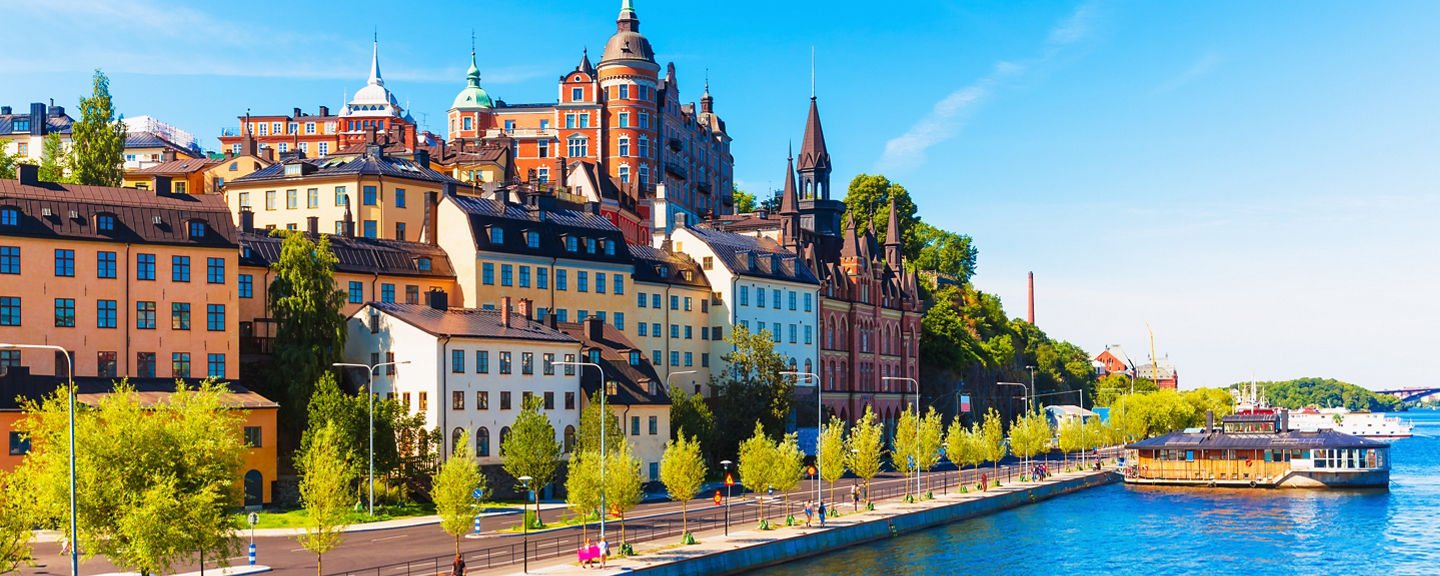
North & Baltic Seas
The North Sea is located between the British Isles and northwestern Europe. This northeastern arm of the Atlantic Ocean covers an area of 220,000 sq mi (570,000 sq km) and is bordered by Great Britain to the south and west, the Orkney and Shetland islands to the northwest, Norway to the northeast, Denmark to the east, Germany and the Netherlands to the southeast and Belgium and France to the south.
Average air temperatures in the North Sea range from 32–40°F (0–4°C) in January and from 55–64°F (13–18°C) in July. During the winter months, storms and gales are frequent. The shallow waters of the North Sea support an abundance of plant and animal life, making this one of Europe’s most productive fishing areas. Cod, haddock and herring are among the most common species. The North Sea is also economically vital for two other reasons—it is an important area for energy production and also one of the busiest shipping zones in the world.
The North Sea and Baltic Sea are connected between Norway and Denmark through sea extensions known as the Skagerrak, Kattegat and the Danish straits.
The Baltic Sea is an arm of the North Atlantic Ocean, which separates the Scandinavian Peninsula from continental Europe. Covering 149,000 sq mi (386,000 sq km), the Baltic is bounded by Denmark, Sweden, Finland, Russia, Estonia, Latvia, Lithuania, Poland and Germany.
Typically, Baltic winters are long and cold, while summers are short and warm, but the region experiences a great deal of climatic variability. The average temperature of Finland during the winter is around 14°F (−10°C), while the southern Baltic experiences average summer temperatures around 63°F (17°C). Fog is common during spring and early summer, and in coastal regions, sea breezes frequently occur in summer.
The Baltic Sea holds great historical significance as the economic heart of the Hanseatic League, a great medieval trading group of northern European ports. Merchants traded largely in fish—especially salted herring and dried cod—and shipbuilding supplies, including softwood timber, hemp for ropes and flax for sailcloth.

-
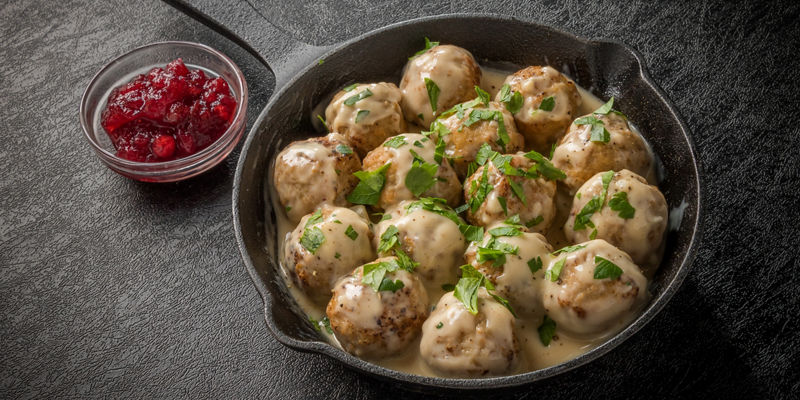
Köttbullar
Köttbullar, the famous Swedish meatballs, are one of the country’s most cherished culinary traditions. Known for their tender texture and rich flavor, these small delicacies have become a symbol of local cuisine, representing warmth, family and the simple pleasures of home-cooked food. In Stockholm, many traditional restaurants proudly serve their own versions of this classic dish, allowing visitors to experience an authentic taste of Swedish culinary heritage.
Swedish meatballs became popular during the 18th century. A widely accepted story suggests that King Charles XII brought inspiration for the dish back to Sweden after spending time in the Ottoman Empire. Over the years, Swedish cooks adapted the concept to local tastes and ingredients, creating the unique version known today. Köttbullar eventually became a staple of Swedish households, and they are often served during family gatherings and on festive occasions.
Traditional köttbullar are made using a mixture of ground beef and pork. The meat is added to finely chopped onions, breadcrumbs soaked in milk, eggs, salt, pepper and sometimes allspice or nutmeg. These ingredients are thoroughly combined to create a smooth, flavorful mixture, which is then rolled into small balls the size of a walnut.
After shaping, the meatballs are browned in butter, which gives them their characteristic golden exterior. Once cooked through, they may be finished in a creamy brown gravy made from pan drippings, broth, cream and seasonings. This rich sauce complements the meatballs perfectly and is a hallmark of many traditional recipes.
Köttbullar are typically served with mashed or boiled potatoes, lingonberry jam and pickled cucumbers. The sweetness of the lingonberries balances the savory meat and creamy sauce, creating a distinctive combination of flavors.
-
Wienerbrød, or Danish pastry
Few baked goods are more closely associated with Denmark than the Danish pastry. Known for its flaky layers, buttery texture and wide variety of fillings, the pastry has become a beloved breakfast and dessert item around the world. Although it is often simply called a “Danish” in English-speaking countries, in Denmark it is known as wienerbrød, meaning “Viennese bread.”
The origins of this beloved treat date to the mid-19th century. In 1850, a labor strike among Danish bakery workers forced owners to hire substitute bakers from other countries, many of whom came from Austria. These Austrian bakers introduced Viennese techniques that differed from traditional Danish methods. Danish bakers soon adapted these recipes, incorporating more butter, eggs and sugar to suit local tastes. Over time, the results evolved into the distinctive products now recognized worldwide as Danish pastries.
The key to this delicacy is its laminated dough, which is created by repeatedly folding layers of butter into yeast-leavened dough. The dough is rolled out, folded and chilled multiple times, creating dozens of thin layers. During baking, moisture in the butter turns to steam, causing the layers to separate and produce the pastry’s characteristic light, flaky texture.
Danish pastries are available in many shapes and varieties. Some are formed into spirals, while others are shaped into pinwheels, braids or squares. Popular fillings include fruit preserves such as raspberry, strawberry or apricot, as well as custard, almond paste, cream cheese and cinnamon. Many wienerbrød are finished with icing, sliced almonds or pearl sugar, adding both flavor and visual appeal.
Traditional bakeries can be found in cities, towns and villages across the country, serving freshly baked pastries alongside coffee or tea. Danishes also dovetail nicely with the local concept of hygge—the appreciation of comfort, relaxation and simple pleasures shared with family and friends.
More than a century and a half after its creation, the Danish pastry remains one of Denmark’s most recognizable culinary exports. Combining Austrian baking traditions with Danish craftsmanship, wienerbrød continues to delight visitors and locals alike as a symbol of the country’s rich baking heritage.
-
Aquavit
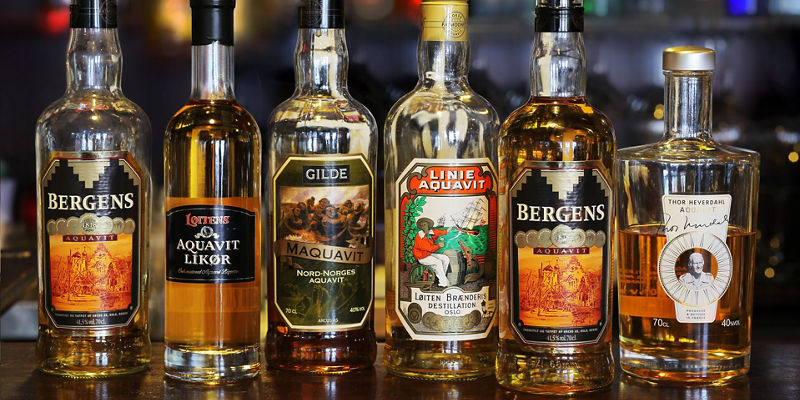
Few beverages are more closely associated with Norway than aquavit, the aromatic spirit that has been enjoyed across Scandinavia for centuries. Derived from the Latin phrase aqua vitae, meaning “water of life,” aquavit is distilled from grain or potatoes and flavored primarily with caraway, dill and other botanicals. In Norway, it has become much more than a drink. It is a symbol of hospitality, celebration and the country’s deep connection to the sea.
Aquavit’s story is especially relevant in Bergen, Norway’s historic maritime capital. For centuries, Bergen served as the nation’s principal trading port and a gateway between Norway and the rest of Europe. Merchants arriving at Bryggen Wharf exchanged culinary traditions that helped shape Norway’s food and drink culture. As Bergen grew into one of Northern Europe’s most important commercial centers, aquavit became a familiar presence at merchants’ tables, festive gatherings and family celebrations.
Today, Norway is particularly renowned for its barrel-aged aquavit. Unlike many Danish and Swedish varieties, Norwegian aquavit is often aged in oak casks, giving it a golden color and notes of vanilla, spice and wood. The country’s most famous expression, Linie Aquavit, undergoes a unique ocean voyage during which the barrels cross the equator and return before bottling. In keeping with another longstanding maritime tradition, Viking christens each of its ocean ships by smashing a bottle of Norwegian aquavit against the vessel, a symbolic ceremony that celebrates the country's seafaring heritage.
Aquavit is traditionally enjoyed alongside classic Norwegian dishes, particularly seafood. Pickled herring, gravlax, smoked salmon and other fish specialties pair naturally with the spirit’s herbal flavors. It is also commonly served during Christmas celebrations, weddings and national holidays, often accompanied by a traditional toast among friends and family.
Travelers visiting Bergen today can experience these traditions throughout the city. The historic Bryggen waterfront, once the center of Hanseatic trade, is home to restaurants and cafés that showcase regional Norwegian cuisine and spirits. Visitors can sample varieties of local aquavit while enjoying views of the harbor that has connected Norway to the wider world for nearly a thousand years. You may also try this delightful spirit on board your ship.
-
Bryggen Wharf
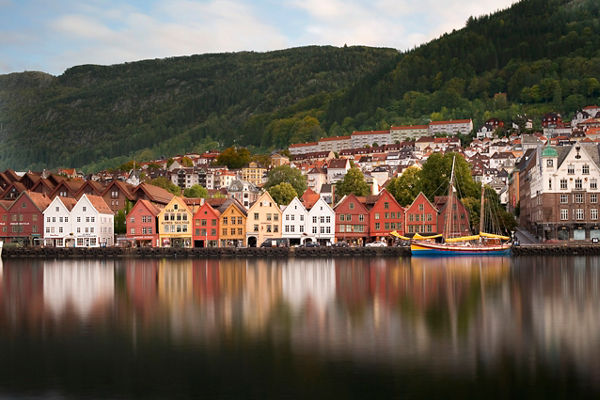
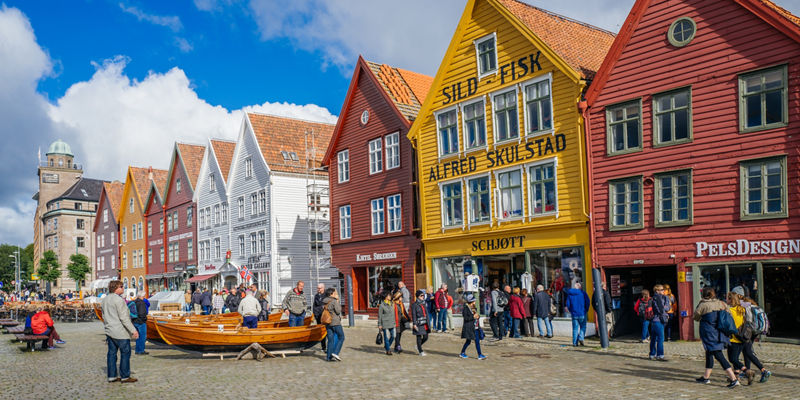
Few sites are as closely associated with Bergen as Bryggen Wharf, the iconic row of colorful wooden buildings that lines the eastern side of the harbor. A UNESCO World Heritage Site since 1979, Bryggen is more than a picturesque landmark. It is a living reminder of Bergen’s role as one of northern Europe’s most important trading centers and a rare survivor of a medieval urban landscape.
The history of Bryggen dates to the early days of Bergen, which was established as a major center of trade along Norway’s west coast during the 11th and 12th centuries. Its strategic location made it a natural hub for commerce, connecting northern Norway with markets across Europe. By around 1350, the powerful Hanseatic League, a network of German merchant cities that dominated trade in northern Europe, established one of its four overseas trading offices in Bergen. Bryggen became the center of Hanseatic commercial activity in Norway, particularly the lucrative trade in stockfish from northern coastal communities.
For centuries, German merchants lived and worked in the tightly packed wooden buildings that characterize Bryggen today. The district developed a distinctive layout, with narrow passageways leading from the waterfront to enclosed courtyards, warehouses and offices. These structures were designed to support the busy trading operations that fueled Bergen’s prosperity and helped shape its identity as a maritime city.
Like much of historic Bergen, Bryggen has endured numerous fires over the centuries. The wooden buildings were repeatedly destroyed and rebuilt, most notably after a devastating fire in 1702. Remarkably, each reconstruction followed the original medieval street plan and building patterns, preserving the character of the district.
Today, Bryggen is one of the best-preserved examples of a Hanseatic trading settlement anywhere in Europe, and it remains one of Norway’s most visited attractions. Travelers can wander its atmospheric alleyways, admire the colorful harbor-facing facades and learn about the lives of the Hanseatic merchants. The district is also home to artisan workshops, galleries, cafés and specialty shops tucked behind the famous waterfront, where you can browse handmade jewelry and sample traditional Norwegian foods like smoked salmon or waffles.
Whether you are visiting for the area’s history, architecture or vibrant atmosphere, Bryggen offers a fascinating glimpse into the centuries of trade and culture that helped shape Bergen and the wider Nordic world.
-
Favorite Baltic dishes
The Baltic Sea has played a large role in shaping this region’s distinctive cuisine, which is marked by an abundance of seafood. Wild game, juniper berries and caraway seeds are other common ingredients. Sour cream is a popular accompaniment to many dishes. Here are four regional favorites that you might encounter during a journey through this captivating part of the world:
- Pelēkie Zirņi ar Speķi (Gray Peas with Bacon)—Latvia
This surprisingly simple Latvian dish is a Christmastime staple. Cooked with bacon and onions, the peas achieve a nutty, comforting flavor. They may be served as a hearty side dish or on their own, with an accompanying glass of kefir. - Cepelinai—Lithuania
One of the most beloved dishes in Lithuanian cuisine, cepelinai are potato dumplings stuffed with minced meat, dry curd cheese, liver or mushrooms. They are often served with a rich, creamy sauce or sour cream. - Kiluvõileib—Estonia
This classic Estonian open-faced sandwich is made with rye bread, butter and pickled sprats, a small oily fish similar to sardines. It is sometimes topped with a poached or hard-boiled egg, green onions or fresh herbs. - Bigos (Hunter’s Stew)—Poland
Bigos is a satisfying, sauerkraut-based stew that is ideal on winter nights. Traditionally prepared with venison, boar or other wild game, this Polish favorite now often contains delectable bites of kielbasa sausage or pork.
- Pelēkie Zirņi ar Speķi (Gray Peas with Bacon)—Latvia
-
Hans Christian Andersen and “The Little Mermaid”
Few figures are more closely associated with Denmark than Hans Christian Andersen (1805–1875). Born in the Danish city of Odense, Hans Christian Andersen rose from humble beginnings to become one of the world’s most celebrated authors. Andersen studied at the University of Copenhagen in 1828 and spent much of the remainder of his life in Copenhagen, where he developed his literary career and became an important figure in Danish cultural life. While he wrote novels, poems and travel literature, he is best remembered for his fairy tales, including “The Ugly Duckling,” “The Snow Queen,” “The Princess and the Pea” and “The Little Mermaid.”
First published in 1837 as part of Andersen’s collection Fairy Tales Told for Children, “The Little Mermaid” tells the story of a young mermaid who longs to leave the sea and experience the human world. After rescuing a prince from a shipwreck, she falls deeply in love with him and sacrifices her beautiful voice to a cunning sea witch in exchange for human legs. The mermaid must also endure constant pain, feeling as though she is walking on sharp knives with every step, and she can only gain an immortal soul if the prince falls in love with and marries her; otherwise, she will die and dissolve into sea foam when he marries another.
Unlike many modern adaptations, Andersen’s original tale is bittersweet and explores themes of love, sacrifice, identity and the desire for an immortal soul. In his version, the unsuccessful mermaid dissolves, but instead of ceasing to exist, she becomes an air spirit and ascends into the atmosphere. The story has been translated into dozens of languages and remains one of the most influential fairy tales ever written.
During the early 20th century, the tale’s connection to Copenhagen became even stronger. In 1909, Carl Jacobsen—a Danish brewer, arts patron and son of the founder of Carlsberg Brewery—attended a ballet adaptation of “The Little Mermaid” at Copenhagen’s Royal Danish Theatre. Inspired by the performance, he commissioned a sculpture depicting the story’s protagonist as a gift to the city.
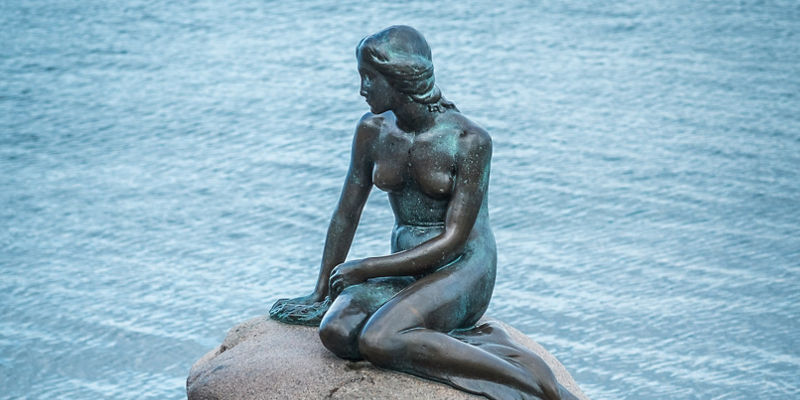
Created by Danish sculptor Edvard Eriksen, The Little Mermaid was unveiled in Copenhagen on August 23, 1913. The statue portrays the mermaid seated on a granite rock, gazing thoughtfully toward the harbor. Eriksen used ballet dancer Ellen Price, who performed the lead role in the ballet, as the model for the figure’s head, while his wife Eline Eriksen served as the model for the body.
Located along the Langelinie waterfront near Kastellet, the sculpture stands just over 4 ft (1.25 m) tall. Despite its relatively modest size, it has become Copenhagen’s most famous landmark and one of the most recognizable monuments in the world.
Although Hans Christian Andersen’s legacy can be found throughout Copenhagen—from museums and memorials to the many locations associated with his life and work—no tribute is more famous than The Little Mermaid. Together, the author, his timeless fairy tale and the waterfront statue represent a unique blend of literature, art and national identity that continues to captivate visitors more than a century after the monument’s unveiling
-
Notable figures associated with Bergen
For centuries, Bergen served as Norway’s principal trading hub and gateway to the North Atlantic, attracting merchants, artists, writers and political leaders whose influence extended far beyond the region. From medieval kings and pioneering playwrights to celebrated composers and modern artists, these individuals reflect Bergen’s enduring legacy of creativity, leadership and innovation.
- King Håkon Håkonsson (1204–1263)
One of the most influential rulers in Norwegian history, King Håkon Håkonsson presided over a period often described as Norway’s medieval golden age. He established Bergen as the center of royal authority and expanded the kingdom’s influence across the North Atlantic. During his reign, he commissioned Håkon’s Hall, a monumental stone assembly hall that remains one of Bergen’s most important historic landmarks. - Ludvig Holberg (1684–1754)
Born in Bergen, the playwright, historian, philosopher and essayist Ludvig Holberg became one of Scandinavia’s most influential literary figures. His satirical comedies challenged social conventions and promoted Enlightenment ideals, helping shape intellectual life throughout Scandinavia. Although much of his career was spent in Copenhagen, his time in Bergen remained an important part of his identity. Today, his legacy continues to be honored with a prominent bronze statue, located in Vågsallmenningen Square. - Ole Bull (1810–1880)
Known as the “Paganini of the North,” Ole Bull was among the nineteenth century’s most celebrated violin virtuosos. His remarkable performances earned international acclaim across Europe and the United States. Beyond his musical achievements, Bull was an ardent supporter of Norwegian culture and national identity. He played a key role in founding the Norwegian Theatre in Bergen, helping promote the use of the Norwegian language in the performing arts. - Amalie Skram (1846–1905)
A pioneering novelist and one of Scandinavia’s most important literary realists, Amalie Skram challenged social norms through her powerful depictions of marriage, class inequality and women’s rights. Her novels, including the renowned tetralogy Hellemyrsfolket (1887–98), offered an uncompromising examination of nineteenth-century society and helped advance discussions about gender and social reform. Today, she is recognized as one of Norway’s most influential writers, and her legacy remains closely associated with her hometown of Bergen. - Edvard Grieg (1843–1907)
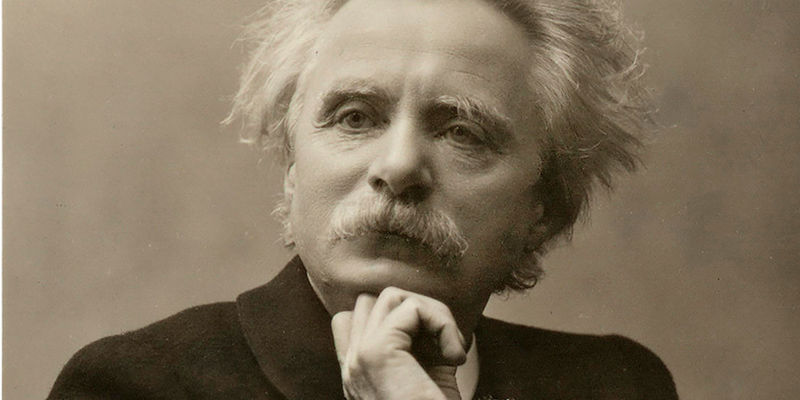
Norway’s best-known composer, Edvard Grieg brought international recognition to Norwegian music through works that drew inspiration from the country’s landscapes, folk traditions and cultural heritage. Compositions such as the Piano Concerto in A Minor, Op. 16, and the Peer Gynt suites remain among the most beloved works of the Romantic era. Grieg spent much of his life in Bergen, and visitors can explore his former home, Troldhaugen, which today serves as a museum and cultural center dedicated to his life and music. - Christian Michelsen (1857–1925)
A successful shipping magnate and politician, Christian Michelsen played a leading role in Norway’s peaceful separation from Sweden in 1905. As the country’s first prime minister after independence, he helped guide Norway through a pivotal moment in its national development. His former residence, Gamlehaugen, now serves as a royal residence and historic landmark outside Bergen. - Nikolai Astrup (1880–1928)
One of Norway’s most distinctive painters, Nikolai Astrup became renowned for his vivid depictions of western Norway’s landscapes, rural traditions and seasonal rhythms. His colorful, expressive works captured the dramatic scenery of the fjord region and helped define a uniquely Norwegian visual identity. Today, his paintings are celebrated in museums throughout Norway, including Bergen’s KODE Art Museums, and remain particularly admired in Bergen and the surrounding region.
- King Håkon Håkonsson (1204–1263)
-
Notable figures associated with Copenhagen
Copenhagen has been shaped by an extraordinary range of scientists, artists and writers whose achievements have left a lasting mark on Denmark and the wider world. From Renaissance kings who transformed the city’s skyline to pioneering thinkers who revolutionized philosophy and physics, these individuals reflect Copenhagen’s enduring role as a center of culture, learning and innovation.
- Tycho Brahe (1546–1601)
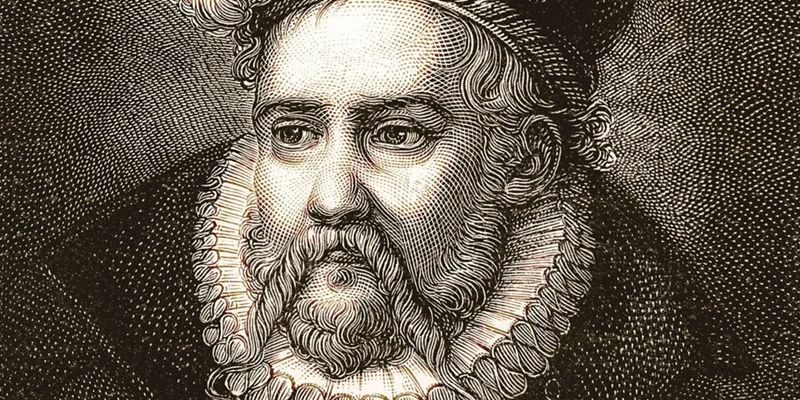
One of the greatest astronomers of the Renaissance, Tycho Brahe revolutionized the study of the heavens through his remarkably precise observations of the planets and stars. Working decades before the invention of the telescope, he collected data that later helped the German astronomer Johannes Kepler formulate the laws of planetary motion. Although best known for his observatories on the island of Hven, Brahe studied law at the University of Copenhagen, and his scientific influence extended throughout Denmark. His legacy remains closely connected to the city through institutions and monuments celebrating Denmark’s contributions to astronomy, including a sculpture at the University of Copenhagen and a bust outside the Round Tower. - King Christian IV (1577–1648)
Few individuals have left a more visible mark on Copenhagen than King Christian IV. During his nearly sixty-year reign, he launched an ambitious building program that transformed the city into one of northern Europe’s most impressive capitals. Many of Copenhagen’s most famous landmarks—including Rosenborg Castle, the Round Tower, Christianshavn and the Stock Exchange building—were constructed under his patronage. His vision helped define the city's architectural character, and his influence remains evident throughout Copenhagen's historic center.
- Bertel Thorvaldsen (1770–1844)
Widely regarded as one of Europe’s greatest neoclassical sculptors, Bertel Thorvaldsen achieved international fame for his elegant marble statues inspired by classical antiquity. After a distinguished career in Rome, he returned to Copenhagen, where he donated much of his artistic collection to the Danish people. The Thorvaldsen Museum, located beside Christiansborg Palace, was built to house his works and serves as both a museum and his final resting place.
- N.F.S. Grundtvig (1783–1872)
Bishop, poet, philosopher and educator, N.F.S. Grundtvig played a transformative role in Danish society during the 19th century. He championed education for ordinary citizens and inspired the folk high school movement, which emphasized lifelong learning, civic participation and cultural awareness. His ideas helped shape modern Danish democracy and national identity. Grundtvig’s influence continues to be felt throughout Denmark, and the monumental Grundtvig’s Church in Copenhagen stands as a lasting tribute to his legacy.
- Søren Kierkegaard (1813–1855)
Born and educated in Copenhagen, Søren Kierkegaard had an outsized influence on the development of existentialist philosophy in the 20th century. Through influential works such as Fear and Trembling (1843) and Either/Or (1843), he explored questions of faith, individual responsibility, freedom and the meaning of human existence. Much of his life unfolded in the streets, churches and cafés of Copenhagen, which served as both the setting and inspiration for his writings. Today, he remains one of Denmark’s most influential intellectual figures.
- Niels Bohr (1885–1962)
A pioneering physicist and Nobel Prize laureate, Niels Bohr transformed modern science through his groundbreaking research on atomic structure and quantum theory. Working in Copenhagen, he established the Institute for Theoretical Physics, which became one of the world's leading centers for scientific research. Scholars from around the globe traveled to the city to collaborate with Bohr, helping make Copenhagen a focal point of 20th-century physics.
- Karen Blixen (1885–1962)
Known internationally by her pen name Isak Dinesen, Karen Blixen was one of Denmark’s most celebrated authors. Her memoir Out of Africa (1937) and story collections such as Seven Gothic Tales (1934) earned worldwide acclaim for their rich narratives and literary artistry. Although she is often associated with her years in Kenya, Blixen spent much of her life near Copenhagen, where her former home, Rungstedlund, now operates as a museum dedicated to her life and work.
- Tycho Brahe (1546–1601)
-
Notable figures associated with Stockholm
From pioneering scholars and the rulers who laid the foundations of the modern Swedish state to celebrated authors and internationally renowned filmmakers, the following individuals illustrate Stockholm’s enduring importance as a center of political power, learning and creativity.
- King Gustav Vasa (1496–1560)
Often regarded as the founder of modern Sweden, Gustav Vasa led the Swedish War of Liberation against Danish rule and was elected king in 1523. His reign transformed Sweden into an independent and centralized nation-state, laying the foundations for the country's future development. Stockholm became the political heart of this emerging kingdom, and Gustav strengthened royal authority through administrative reforms, economic modernization and the establishment of a national church during the Protestant Reformation. His legacy remains deeply woven into the city’s history, particularly through the Royal Palace area and the institutions that emerged under his rule. - Queen Christina (1626–1689)
One of Sweden’s most remarkable monarchs, Queen Christina was renowned for her intellect, curiosity and patronage of the arts and sciences. During her reign (1632–1654), Stockholm flourished as a center of European learning and culture. She invited leading scholars, philosophers and artists to her court, helping to elevate Sweden's international reputation. She famously abdicated her throne in 1654 due to her conversion to Catholicism, refusal to marry and desire to pursue a life outside the expectations of a Protestant monarch. Nevertheless, her commitment to education and intellectual inquiry left a lasting impact on Stockholm’s cultural development. - Carl Linnaeus (1707–1778)
The pioneering botanist, physician and naturalist Carl Linnaeus revolutionized the study of living organisms through his system of binomial nomenclature, which remains the foundation of biological classification today. Although closely associated with Uppsala, Linnaeus frequently worked in Stockholm and was instrumental in establishing the Royal Swedish Academy of Sciences there in 1739. - Alfred Nobel (1833–1896)
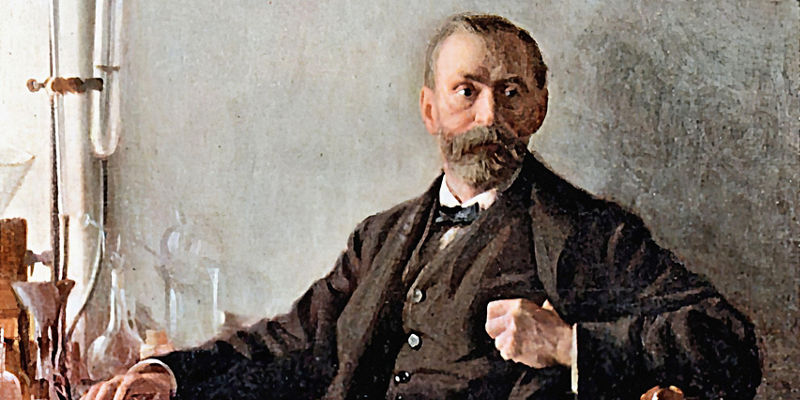
Chemist, engineer and entrepreneur Alfred Nobel achieved worldwide recognition through his invention of dynamite and numerous other scientific innovations. Toward the end of his life, he dedicated his vast fortune to establishing the Nobel Prizes, which honor outstanding achievements in science, literature and peace. Stockholm became the permanent home of the Nobel institutions and annual Nobel Prize ceremonies—apart from the Nobel Peace Prize ceremony—making the city synonymous with excellence and global achievement. - August Strindberg (1849–1912)
Widely regarded as Sweden’s greatest playwright, August Strindberg transformed modern literature and theater through his experimental and psychologically complex works. Plays such as Miss Julie (1888) and The Father (1887) helped pioneer modern dramatic realism and influenced generations of writers and directors. Much of Strindberg’s life unfolded in Stockholm, which frequently served as both the setting and inspiration for his writing. Today, the Strindberg Museum preserves his legacy in the city he knew so well. - Astrid Lindgren (1907–2002)
Among Sweden’s most beloved authors, Astrid Lindgren captivated generations of readers with unforgettable characters, such as Pippi Longstocking, Emil of Lönneberga and Karlsson-on-the-Roof. Living much of her adult life in Stockholm, she produced stories celebrated for their imagination, humor and respect for childhood independence. Her books have been translated into dozens of languages, making her one of the most widely read children's authors in the world. - Ingmar Bergman (1918–2007)
One of cinema’s most influential directors, Ingmar Bergman earned international acclaim for profound and visually striking films such as The Seventh Seal (1957), Wild Strawberries (1957) and Fanny and Alexander (1982). Through his exploration of faith, identity, mortality and human relationships, Bergman helped establish Sweden as a major force in world cinema. His long association with Stockholm’s theaters and film institutions cemented the city's reputation as a center of artistic innovation. - Stieg Larsson (1954–2004)
Journalist and novelist Stieg Larsson transformed contemporary crime fiction through his internationally bestselling Millennium series. Centered largely in Stockholm, particularly the Södermalm district, his novels combined compelling mysteries with sharp social commentary on politics, corruption and journalism. Following the global success of The Girl with the Dragon Tattoo and its sequels, Larsson helped popularize Scandinavian crime fiction and introduced millions of readers to modern Stockholm.
- King Gustav Vasa (1496–1560)
-
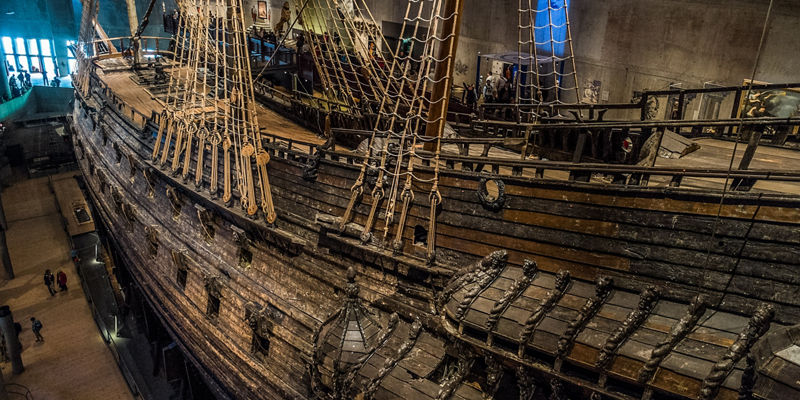
The Vasa warship
Commissioned by King Gustavus Adolphus during Sweden’s rise as a European power, the Vasa was designed to be one of the most formidable warships of its time. Stretching 226 ft (69 m) in length and armed with 64 bronze cannons, it was intended to showcase Sweden’s military strength and royal prestige. Richly decorated with hundreds of painted carvings and sculptures, the ship was as much a political statement as a naval vessel.
However, the Vasa’s story took a tragic turn on August 10, 1628. Shortly after it departed Stockholm Harbor on its maiden voyage, a gust of wind caused the top-heavy ship to tilt sharply to the port side. Although the ship briefly regained balance, a second, stronger gust pushed it even farther, allowing water to rush through the open gun ports. The Vasa then rolled onto its side and sank rapidly, only minutes after setting sail in front of thousands of spectators. An official inquiry followed, but no single individual was held responsible for the disaster.
Modern engineers and naval architects have concluded that the Vasa sank because of fundamental flaws in its design. Studies conducted after the ship’s recovery showed that it could have capsized in even a mild four-knot wind. Its high center of gravity—created by the large number of heavy cannons mounted on two gun decks and the substantial decorative sculptures adorning the bow—made the vessel dangerously unbalanced.
For 333 years, the Vasa remained on the seabed of Stockholm Harbor. Thanks to the Baltic Sea’s cold, low-oxygen waters, much of the ship survived in extraordinary condition. After it was rediscovered in the 1950s, an ambitious salvage operation culminated in the vessel’s successful recovery in 1961. Extensive conservation efforts followed, preserving this impressive artifact for future generations.
Today, few attractions in Stockholm capture Sweden’s history as dramatically as the Vasa Museum. Visitors can take in the massive, painstakingly restored vessel and learn about 17th-century naval power, craftsmanship and everyday life at sea.
-
The Hanseatic League
The Hanseatic League (or Hansa, which means “fleet” or “convoy”) was an organization of merchant guilds and market towns in Northwestern and Central Europe that began in the late 1100s and grew to dominate Baltic trade for three centuries. The League was formalized in 1356 in the German city of Lübeck, in partnership with Hamburg, but it established trading centers from the Netherlands to Bergen and beyond.
Hansa members originally joined forces to facilitate trade and protect their mutual interests. In addition to achieving impressive financial success, the League had other far-reaching effects on society. For example, their organization represented one of the first systematic challenges to the absolute power of the nobility. Under the feudal system, the ruling class could impose taxes on other citizens, including merchants and artisans. Guilds became an effective means of resisting oppression and extortion by the upper class.
Some League members raised their own armies to help maintain order. Crime was rampant on the highways and seas, and the League’s forces provided much-needed protection against thieves and pirates.
The Hanseatic League also provided benefits for the community, such as developing infrastructure and establishing almshouses, hospitals, orphanages and old age homes. These charitable activities increased the League’s popularity within the general population. They also inclined the nobility to be more tolerant, since the nobles were then relieved of having to provide these services themselves. Guilds also offered consumer protections, for example, setting standards for quality, production and fair pricing.
By the 15th century, the Hanseatic League was on the wane, due to a “perfect storm” of challenges. The bubonic plague swept across Europe, killing nearly half the population and depleting the workforce. Climate change in the form of a “mini-Ice Age” caused widespread crop failure and depression. The rising Swedish Empire took control of Baltic sea routes, and internal rivalries caused the League to fracture. By 1862, the League was dissolved.
However, a new Hansa initiative began in 1980 and was formalized in 2018. Members include 192 European cities and towns, whose mission is to spread economic, social, cultural and civic unity.
-
The history of the Scottish Gaelic language
The Gaelic (pronounced Gallic) language traveled from Ireland to Scotland more than 1,500 years ago. The two lands are separated at their nearest point by just 12 mi (19 km) of sea, so it is hardly surprising that, along with migrants and raiders, the Irish Gaelic language also reached Scotland. Scottish Gaelic is one of six Celtic languages that originated in the British Isles—the others being Irish Gaelic, Welsh, Cornish, Manx (spoken in the UK’s Isle of Man) and Breton (spoken in Brittany, France).
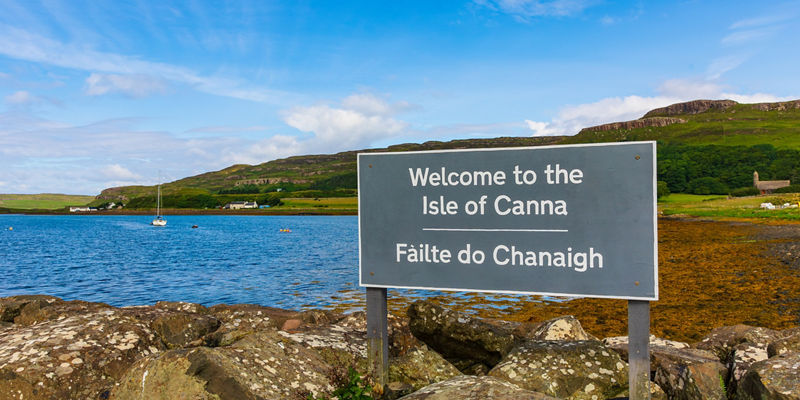
Although Scottish Gaelic, or Gàidhlig, developed from Irish Gaelic, it has a distinct dialect, vocabulary and alphabet. The Scottish Gaelic alphabet has 18 letters, and each is given the name of a tree or plant. For example, A is elm (ailm) and U is heather (ura). Vowels may also be written with a grave accent (or stràc) to denote a more prolonged, drawn-out sound.
During the 11th century, Gaelic was the main language spoken in Scotland, but over time, cultural, religious and population changes began to influence which languages were spoken. By the start of the 19th century, Gaelic was actively repressed. One factor that played an important part in the repression of Scottish Gaelic was the “Highland Clearances” of the 18th and 19th centuries, when many Scots were driven off their land. Poverty forced many to emigrate, taking their Gaelic language and culture with them. Canada, New Zealand and the US were popular destinations. Many places, like Nova Scotia, still have notable Gaelic-speaking populations.
By the end of the 19th century, English had been established as the primary language in Scotland, although citizens of the Highlands and the Outer Hebrides still proudly guarded their language. Today, around 55 percent of Scotland’s Gaelic speakers still live along the west coast in Skye, the Western Isles and Argyll Islands, which are now regarded as the “Gaelic heartland.” However, Gaelic-speaking communities still exist in most Scottish cities.
Scottish Gaelic is now recognized as an Indigenous language of Scotland, and it was made an official language of Scotland under the Gaelic Language (Scotland) Act 2005. Many Gaelic words have found their way into English usage, such as loch and glen. Road signs can be seen in Gaelic throughout Scotland, and it is spoken widely on radio and TV channels.


North & Baltic Seas Highlights
Embark on an unforgettable voyage through the North and Baltic Seas and discover the idyllic landscapes, lively cities and vibrant cultures of this historic region. Here are some highlights you may experience along the way:
- Enjoy an after-hours visit to the legendary Tower of London
- Sample cask whiskies during a visit to a Scottish distillery
- Try your hand at Viking pastimes in the Orkney Islands
- Learn about the world-famous ponies of the Shetland Islands
- Embark on a seaplane journey over Norway's stunning fjords
- Kayak the pristine waters of the Åland Islands
- Explore Gamla Stan, Stockholm’s 13th-century Old Town
- Listen to live jazz during a Copenhagen canal cruise
- Attend a chocolate-making class in charming Tallinn
- See grand Art Nouveau architecture in Latvia’s capital, Riga
- Cycle through the UNESCO-listed Curonian Spit in Lithuania
- Discover the history of Baltic amber at Gdańsk’s Amber Museum
Destination Insight Videos

Exploring Holland - Amsterdam to Kinderdijk (30:48)
Long-time Viking family member and renowned British photographer Alastair Miller begins his journey in Amsterdam, where he reveals the cultural treasures of the Netherlands’s historic capital. Join Alastair as he peruses unique shops (Posthumuswinkel) and a colorful flower market, pedals through the city and visits the owner of a houseboat museum. After stepping on board Viking Kara, one of our award-winning Viking Longships, he sails to Kinderdijk to meet with locals who care for the iconic windmills.

The Essence of Norway: Edvard Grieg (3:03)
Edvard Grieg composed some of Norway’s most beautiful music, including the much-loved Peer Gynt. Visit his home, listen to his music and admire the natural beauty that inspired him.

Tour Norway’s capital with Alastair Miller (51:38)
Join British photographer Alastair Miller on a tour through Oslo. He knows this vibrant city and its scenic surroundings very well—his prints of Norwegian landscapes are featured on board our ships. Follow along to marvel at majestic natural wonders near Oslo and learn about popular outdoor activities enjoyed by locals and visitors alike. Alastair also tours the beautifully preserved home of one of Norway’s greatest explorers, Nobel Peace Prize laureate Fridtjof Nansen, and visits the Munch Museum, where you can gain a deeper appreciation of the work of Norway’s beloved expressionist artist, Edvard Munch.

North & Baltic Seas Travel FAQ
All-Inclusive Itineraries—North & Baltic Seas
Choose one of our enriching, all-inclusive voyages and discover the many benefits of exploring in Viking comfort.