1. Rivers
  2. Oceans
  3. Expeditions
  1. Complimentary Brochures
Call Viking at 1-800-304-9616 or Contact Your Travel Advisor
Viking Viking Viking
Please fill out this field
Menu
  1. Rivers
  2. Expeditions
Please fill out this field
Use enter or spacebar key to select the link
Use enter or spacebar key to expand or collapse the menu
    • Find A Cruise
    • Destination Map
    • Special Offers
    • New Itineraries
    • Regions

      Europe

      • British Isles & Ireland
      • Mediterranean
      • Scandinavia
      • Other Destinations

      Africa & Middle East

      North America

      • Alaska
      • Canada
      • Mexico
      • United States
      • Other Destinations

      Caribbean & Central America

      South America

      Asia

      Australia & New Zealand

    • Waterways
      • Mediterranean Sea
      • North & Baltic Seas
      • Caribbean Sea
      • Panama Canal
      • Atlantic Ocean
      • Pacific Ocean
      • Indian Ocean
      • Arctic Ocean
    • Seasonal & Combination
      • Italy: Always in Season
      • Quiet Season Mediterranean
      • Northern Lights
      • Panama Canal
      • World Cruises
      • Grand Journeys
      • Ocean Crossings
      • River + Ocean Combinations
    • Other Cruise Types
      • Expeditions
      • Rivers
    • Fleet Overview
    • 360° Ship Tour
    • Ocean Ships
      • Viking Astrea
      • Viking Jupiter
      • Viking Leda
      • Viking Libra
      • Viking Lyra
      • Viking Mars
      • Viking Mira
      • Viking Neptune
      • Viking Orion
      • Viking Saturn
      • Viking Sea
      • Viking Sky
      • Viking Star
      • Viking Vega
      • Viking Vela
      • Viking Venus
      • Viking Vesta
    • The Viking Difference
    • Webinars
    • Did You Know?
    • Cultural Partners
    • Awards
    • My Viking Story
    • Community
    • News
    • Complimentary Brochures
    • One Viking
    • Pre & Post Extensions Overview
    • Shore Excursions Overview
    • My Viking Journey
    • Viking Air
    • Updates on Current Sailings
    • Travel Information
    • Travel Protection Plan
    • Frequently Asked Questions
    • Silver Spirits Beverage Package
    • Why Viking
    • Cruise Itineraries
    • Destination Insights
    • Ships
    • All
Please fill out this field
Speak with a Viking agent to get expert help in building your journey.
Call Now 1-800-304-9616
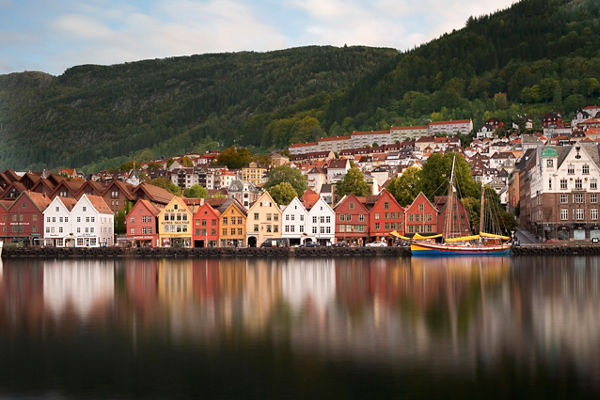
Colorful waterfront houses in Bergen, Norway

Discover the spirit of Bergen

Framed by seven mountains and the waters of Norway’s west coast, Bergen offers visitors a vibrant cultural scene, spectacular natural surroundings and centuries of fascinating maritime history. Read on to learn about a beloved Norwegian spirit, delve into the lives of some of Bergen’s most celebrated cultural figures and uncover the captivating history of Bryggen Wharf.
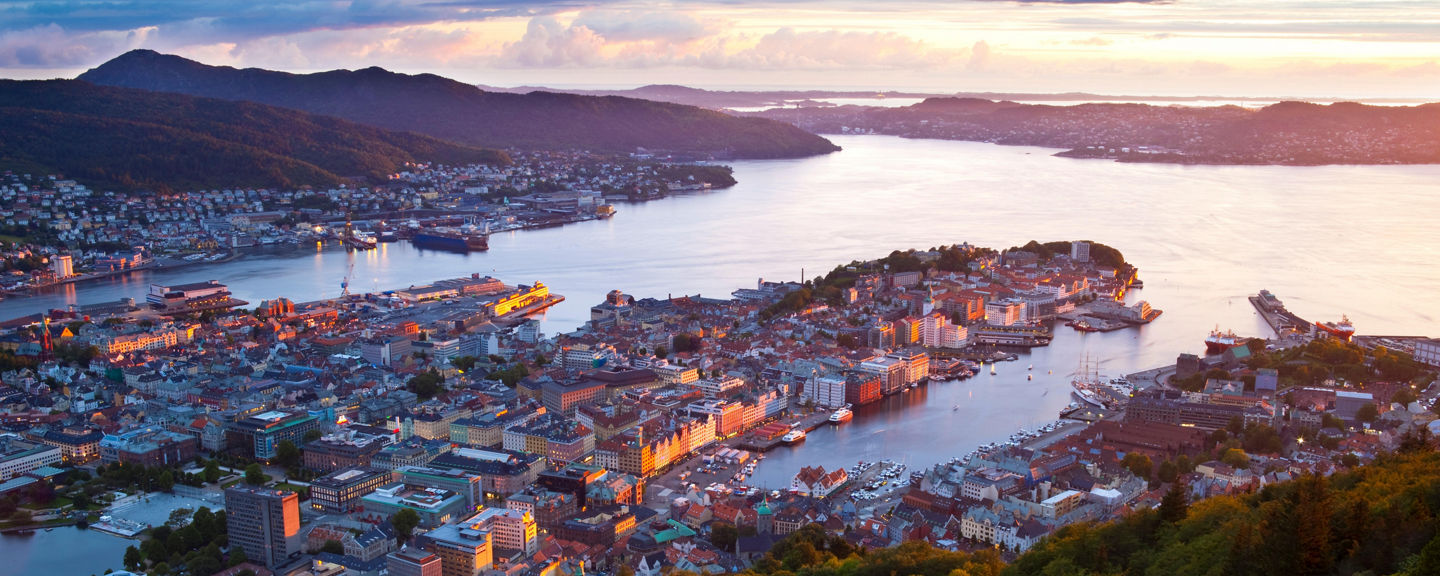
Scenic sunset view of Bergen cityscape

Bergen

Bergen lies along the nation’s southwestern coastline, framed by seven majestic mountains and the Byfjorden, a scenic waterway that is part of the region’s larger fjord system. Known as the “Gateway to the Fjords,” Bergen occupies a prime location on Norway’s western shore, where protected harbors have fostered commerce, fishing and seafaring traditions for generations.

The city’s historic center is defined by colorful wooden buildings, narrow streets and the iconic waterfront district of Bryggen. While Bergen embraces its medieval heritage, it is also renowned for its thriving arts scene, modern museums and vibrant universities. Visitors can explore centuries-old merchant quarters, enjoy contemporary cultural attractions and experience a maritime atmosphere that reflects Bergen’s enduring connection to the sea.

Bergen experiences a temperate oceanic climate heavily influenced by the North Atlantic. Summers are generally mild, with average temperatures ranging from 55°F to 68°F (13°C to 20°C), while winter temperatures typically range between 30°F and 45°F (-1°C to 7°C). The city is one of Norway’s rainiest, a consequence of moist Atlantic air meeting the surrounding mountains. This abundant rainfall contributes to the lush landscapes that characterize the region.

Bergen was founded in 1070 by King Olav Kyrre and quickly emerged as one of medieval Norway’s most important cities. By the 12th and 13th centuries, it had become a center of royal administration and international commerce. Its importance increased further when merchants from the Hanseatic League established a trading office there around 1350. The Hanseatic League was a powerful network of merchant guilds and trading cities, primarily from northern Germany and the Baltic region, that dominated much of northern European trade during the late Middle Ages. For centuries, Bergen served as northern Europe’s principal center for the export of stockfish, air-dried cod preserved without salt, linking the kingdom to markets throughout the continent.

Although fire repeatedly damaged the city’s predominantly wooden architecture, Bergen was rebuilt many times while retaining its historic character. The most devastating of these disasters was the Great Fire of 1702, which destroyed much of the city and left thousands homeless, prompting a major reconstruction effort. The city faced another major catastrophe during World War II when the Dutch transport ship Voorbode, carrying arms for the German occupation forces, exploded in Bergen’s harbor on April 20, 1944. The blast severely damaged several historic landmarks—including Bryggen—but they were all subsequently restored according to the medieval plans. In 1979, the buildings of Bryggen were recognized as a UNESCO World Heritage Site. They stand as a testament to the community’s resilience.

Today, Bergen is among Scandinavia’s most captivating destinations, offering visitors a blend of medieval history, spectacular natural scenery and vibrant cultural life. Below are some of the most notable attractions:

  • Bryggen Wharf—Bergen’s most famous landmark, Bryggen is a UNESCO World Heritage Site consisting of colorful wooden merchant buildings lining the harbor. Once the center of Hanseatic trade in Norway, the district preserves the atmosphere and architectural character of a medieval trading settlement. Today, its narrow alleyways house museums, artisan workshops, galleries and cafés.
  • Fløibanen and Mount Fløyen—One of Norway’s best-known attractions, the Fløibanen funicular transports visitors from the city center to the summit of Mount Fløyen in just a few minutes. The mountaintop offers panoramic views of Bergen, the surrounding islands and nearby fjords, along with a network of scenic walking trails.
  • Bergen Fish Market—Located near the harbor, Bergen’s fish market has been an important trading place for centuries. Visitors can sample fresh seafood including salmon, shrimp, cod and king crab while gaining a taste of Bergen’s enduring seafaring heritage.
  • Bergenhus Fortress—Among the oldest and best-preserved fortifications in Norway, Bergenhus Fortress has guarded the harbor since the Middle Ages. The complex includes Håkon’s Hall—built between 1247 and 1261 by King Håkon Håkonsson as a royal residence and banqueting hall—and the Rosenkrantz Tower, constructed in the 1560s atop earlier medieval defenses.
  • St. Mary’s Church—Built during the 12th century, St. Mary’s Church is Bergen’s oldest surviving building. Closely associated with the Hanseatic merchants who dominated trade in the city, it is among the finest examples of Romanesque architecture in Norway.
  • Troldhaugen—The former home of composer Edvard Grieg (1843–1907) is now a museum and cultural center dedicated to Norway’s most celebrated musician. Visitors can tour the villa, view Grieg’s composing hut and attend concerts honoring his legacy.
  • KODE Art Museums—One of Scandinavia’s largest museum complexes, the KODE Art Museums house extensive collections of Norwegian and international art, decorative arts and music history. They feature works by the celebrated Norwegian painter and printmaker Edvard Munch, the modernist painter Nikolai Astrup and many other prominent artists.
  • Fantoft Stave Church—Originally built in the 12th century and later reconstructed after a devastating fire, Fantoft Stave Church showcases the distinctive wooden church architecture for which Norway is renowned. Its intricate carvings evoke the country's medieval and Viking heritage.
  • Gamlehaugen—Often referred to as Bergen’s royal residence, Gamlehaugen was originally the home of statesman Christian Michelsen, Norway’s first prime minister following the country’s independence from Sweden in 1905. Today, the elegant estate serves as an official royal residence and historic attraction.
  • The Hanseatic Museum and Schøtstuene—This museum explores the lives and activities of the German merchants who operated Bergen’s Hanseatic trading office for centuries. You may also tour the merchants’ Schøtstuene, traditional assembly halls used during the Middle Ages.
  • Bergen Maritime Museum—Located in central Bergen, the Bergen Maritime Museum explores Norway’s enduring connection to the sea. Artifacts, ship models and engaging exhibits trace the development of Scandinavian seafaring, from Viking voyages and medieval commerce to Bergen’s Hanseatic heritage and Norway’s rise as a modern maritime nation.
Historic stone hall with wooden vaulted ceiling
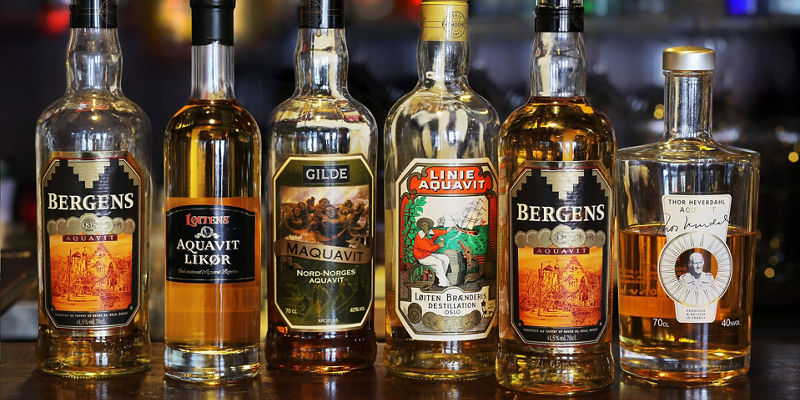
  • Assorted aquavit bottles on a bar counter

    Aquavit

    Few beverages are more closely associated with Norway than aquavit, the aromatic spirit that has been enjoyed across Scandinavia for centuries. Derived from the Latin phrase aqua vitae, meaning “water of life,” aquavit is distilled from grain or potatoes and flavored primarily with caraway, dill and other botanicals. In Norway, it has become much more than a drink. It is a symbol of hospitality, celebration and the country’s deep connection to the sea.

    Aquavit’s story is especially relevant in Bergen, Norway’s historic maritime capital. For centuries, Bergen served as the nation’s principal trading port and a gateway between Norway and the rest of Europe. Merchants arriving at Bryggen Wharf exchanged culinary traditions that helped shape Norway’s food and drink culture. As Bergen grew into one of Northern Europe’s most important commercial centers, aquavit became a familiar presence at merchants’ tables, festive gatherings and family celebrations.

    Today, Norway is particularly renowned for its barrel-aged aquavit. Unlike many Danish and Swedish varieties, Norwegian aquavit is often aged in oak casks, giving it a golden color and notes of vanilla, spice and wood. The country’s most famous expression, Linie Aquavit, undergoes a unique ocean voyage during which the barrels cross the equator and return before bottling. In keeping with another longstanding maritime tradition, Viking christens each of its ocean ships by smashing a bottle of Norwegian aquavit against the vessel, a symbolic ceremony that celebrates the country's seafaring heritage.

    Aquavit is traditionally enjoyed alongside classic Norwegian dishes, particularly seafood. Pickled herring, gravlax, smoked salmon and other fish specialties pair naturally with the spirit’s herbal flavors. It is also commonly served during Christmas celebrations, weddings and national holidays, often accompanied by a traditional toast among friends and family.

    Travelers visiting Bergen today can experience these traditions throughout the city. The historic Bryggen waterfront, once the center of Hanseatic trade, is home to restaurants and cafés that showcase regional Norwegian cuisine and spirits. Visitors can sample varieties of local aquavit while enjoying views of the harbor that has connected Norway to the wider world for nearly a thousand years. You may also try this delightful spirit on board your ship.

  • Colorful wooden buildings in historic street

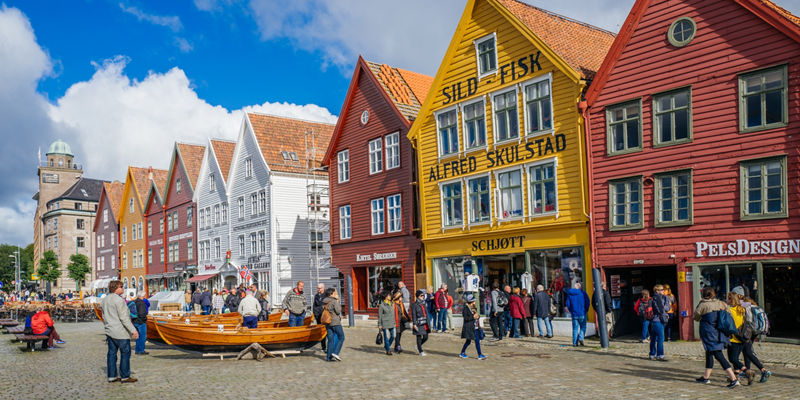
    Bryggen Wharf

    Few sites are as closely associated with Bergen as Bryggen Wharf, the iconic row of colorful wooden buildings that lines the eastern side of the harbor. A UNESCO World Heritage Site since 1979, Bryggen is more than a picturesque landmark. It is a living reminder of Bergen’s role as one of northern Europe’s most important trading centers and a rare survivor of a medieval urban landscape.

    The history of Bryggen dates to the early days of Bergen, which was established as a major center of trade along Norway’s west coast during the 11th and 12th centuries. Its strategic location made it a natural hub for commerce, connecting northern Norway with markets across Europe. By around 1350, the powerful Hanseatic League, a network of German merchant cities that dominated trade in northern Europe, established one of its four overseas trading offices in Bergen. Bryggen became the center of Hanseatic commercial activity in Norway, particularly the lucrative trade in stockfish from northern coastal communities.

    For centuries, German merchants lived and worked in the tightly packed wooden buildings that characterize Bryggen today. The district developed a distinctive layout, with narrow passageways leading from the waterfront to enclosed courtyards, warehouses and offices. These structures were designed to support the busy trading operations that fueled Bergen’s prosperity and helped shape its identity as a maritime city.

    Like much of historic Bergen, Bryggen has endured numerous fires over the centuries. The wooden buildings were repeatedly destroyed and rebuilt, most notably after a devastating fire in 1702. Remarkably, each reconstruction followed the original medieval street plan and building patterns, preserving the character of the district.

    Today, Bryggen is one of the best-preserved examples of a Hanseatic trading settlement anywhere in Europe, and it remains one of Norway’s most visited attractions. Travelers can wander its atmospheric alleyways, admire the colorful harbor-facing facades and learn about the lives of the Hanseatic merchants. The district is also home to artisan workshops, galleries, cafés and specialty shops tucked behind the famous waterfront, where you can browse handmade jewelry and sample traditional Norwegian foods like smoked salmon or waffles.

    Whether you are visiting for the area’s history, architecture or vibrant atmosphere, Bryggen offers a fascinating glimpse into the centuries of trade and culture that helped shape Bergen and the wider Nordic world.

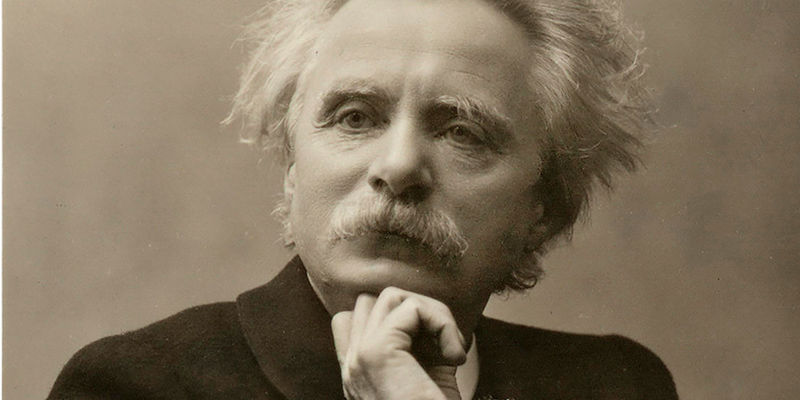
  • Vintage portrait of thoughtful older man

    Notable figures associated with Bergen

    For centuries, Bergen served as Norway’s principal trading hub and gateway to the North Atlantic, attracting merchants, artists, writers and political leaders whose influence extended far beyond the region. From medieval kings and pioneering playwrights to celebrated composers and modern artists, these individuals reflect Bergen’s enduring legacy of creativity, leadership and innovation.

    • King Håkon Håkonsson (1204–1263)
      One of the most influential rulers in Norwegian history, King Håkon Håkonsson presided over a period often described as Norway’s medieval golden age. He established Bergen as the center of royal authority and expanded the kingdom’s influence across the North Atlantic. During his reign, he commissioned Håkon’s Hall, a monumental stone assembly hall that remains one of Bergen’s most important historic landmarks.
    • Ludvig Holberg (1684–1754)
      Born in Bergen, the playwright, historian, philosopher and essayist Ludvig Holberg became one of Scandinavia’s most influential literary figures. His satirical comedies challenged social conventions and promoted Enlightenment ideals, helping shape intellectual life throughout Scandinavia. Although much of his career was spent in Copenhagen, his time in Bergen remained an important part of his identity. Today, his legacy continues to be honored with a prominent bronze statue, located in Vågsallmenningen Square.
    • Ole Bull (1810–1880)
      Known as the “Paganini of the North,” Ole Bull was among the nineteenth century’s most celebrated violin virtuosos. His remarkable performances earned international acclaim across Europe and the United States. Beyond his musical achievements, Bull was an ardent supporter of Norwegian culture and national identity. He played a key role in founding the Norwegian Theatre in Bergen, helping promote the use of the Norwegian language in the performing arts.
    • Amalie Skram (1846–1905)
      A pioneering novelist and one of Scandinavia’s most important literary realists, Amalie Skram challenged social norms through her powerful depictions of marriage, class inequality and women’s rights. Her novels, including the renowned tetralogy Hellemyrsfolket (1887–98), offered an uncompromising examination of nineteenth-century society and helped advance discussions about gender and social reform. Today, she is recognized as one of Norway’s most influential writers, and her legacy remains closely associated with her hometown of Bergen.
    • Edvard Grieg (1843–1907)
      Norway’s best-known composer, Edvard Grieg brought international recognition to Norwegian music through works that drew inspiration from the country’s landscapes, folk traditions and cultural heritage. Compositions such as the Piano Concerto in A Minor, Op. 16, and the Peer Gynt suites remain among the most beloved works of the Romantic era. Grieg spent much of his life in Bergen, and visitors can explore his former home, Troldhaugen, which today serves as a museum and cultural center dedicated to his life and music.
    • Christian Michelsen (1857–1925)
      A successful shipping magnate and politician, Christian Michelsen played a leading role in Norway’s peaceful separation from Sweden in 1905. As the country’s first prime minister after independence, he helped guide Norway through a pivotal moment in its national development. His former residence, Gamlehaugen, now serves as a royal residence and historic landmark outside Bergen.
    • Nikolai Astrup (1880–1928)
      One of Norway’s most distinctive painters, Nikolai Astrup became renowned for his vivid depictions of western Norway’s landscapes, rural traditions and seasonal rhythms. His colorful, expressive works captured the dramatic scenery of the fjord region and helped define a uniquely Norwegian visual identity. Today, his paintings are celebrated in museums throughout Norway, including Bergen’s KODE Art Museums, and remain particularly admired in Bergen and the surrounding region.

Bergen Highlights

With its storied past, vibrant waterfront and easy access to Norway’s majestic fjords, Bergen presents a compelling blend of heritage, beauty and local character. Here are some highlights you may experience during a visit to this enchanting city:

  • Stroll the UNESCO-listed Bryggen Wharf
  • Ascend Mount Fløyen on the Fløibanen funicular
  • Discover the bustling Bergen Fish Market
  • Admire medieval Hanseatic architecture
  • Visit Bergenhus Fortress and its grounds
  • Attend a Norwegian music performance in a local home
  • Sample local cuisine during a culinary walking tour
  • Explore the Hanseatic Museum and Schøtstuene assembly halls
  • Enjoy an Ulriken Bun, a cinnamon pastry, atop Mt. Ulriken
  • Watch local artisans craft gold and silver jewelry
  • Cycle along the shores of the Byfjorden on e-bike
  • Venture into Norway’s dramatic fjords

Bergen Travel FAQ

With its spectacular setting between mountains and fjords, Bergen is an appealing destination in every season. Spring and autumn bring mild weather, fewer crowds and excellent opportunities to explore the city’s museums, markets and scenic harbor. Winter lends a cozy atmosphere to Bergen’s historic streets, while snow-dusted peaks create dramatic backdrops for sightseeing. In summer, long daylight hours make it ideal to stroll Bryggen Wharf, ride the Fløibanen funicular to the top of Mount Fløyen or venture into Norway’s breathtaking landscapes.

One of the most popular ways to experience Bergen is by exploring its historic waterfront and maritime heritage. Visitors can stroll the UNESCO-listed Bryggen Wharf, where colorful wooden buildings recall the city’s status as a major Hanseatic trading port. Walking tours through the old town provide insight into Bergen’s role in medieval commerce, while visits to nearby landmarks such as Bergenhus Fortress and St. Mary’s Church reveal the city’s rich history.

The city’s maritime traditions remain an important part of daily life. Bergen’s famous Fish Market offers opportunities to sample local seafood and experience a trading tradition that has endured for centuries. Walking tours focused on local culture often combine visits to the market with explorations of Bergen’s historic neighborhoods, allowing travelers to gain a deeper appreciation of the city’s connection to the sea.

Bergen is also renowned for its spectacular scenery. Many visitors ride the Fløibanen funicular to the summit of Mount Fløyen, where panoramic views stretch across the harbor, surrounding islands and mountain peaks. The city also serves as a gateway to some of the country’s most breathtaking fjords. Popular excursions include cruises or seaplane journeys through these legendary waterways framed by towering mountains and cascading waterfalls.

Yes. Bergen is home to Bryggen, one of Norway’s most celebrated UNESCO World Heritage Sites. Located along the city’s historic harbor, Bryggen is a remarkably preserved Hanseatic merchant district that reflects Bergen’s importance as a major center of trade between Norway and continental Europe during the Middle Ages. The site was inscribed on UNESCO’s World Heritage List in 1979 as an outstanding example of a medieval wooden trading settlement and one of the best-preserved remnants of the Hanseatic League’s commercial network.

Beyond Bergen itself, visitors can also explore the West Norwegian Fjords, a UNESCO World Heritage Site recognized since 2005 for its exceptional natural beauty and geological significance. Bergen serves as one of the principal gateways to the region, and day trips from the city are among the most popular experiences for travelers seeking to discover Norway’s iconic fjords. Situated northeast of Bergen, the protected landscapes include Nærøyfjord, located approximately 75 mi (120 km) from the city, and Geirangerfjord, farther to the north and about 75 mi (120 km) beyond Nærøyfjord.

Located at the heart of Bergen, Bryggen forms the city’s historic and cultural core. Home to many of the city’s most important attractions, including the UNESCO-listed Bryggen Wharf, museums, shops, cafés and harbor promenades, the area offers an ideal introduction to Bergen’s rich maritime heritage and contemporary urban life.

To the west, Nordnes occupies a scenic peninsula between Bergen’s harbor and the Byfjord. The neighborhood is characterized by narrow cobblestone streets, white-painted wooden houses and a relaxed residential atmosphere. Its waterfront parks and viewpoints provide beautiful vistas across the harbor, while its historic character offers visitors a glimpse of everyday life in one of Bergen’s oldest districts.

Stretching northward along the coastline, Sandviken preserves much of Bergen’s traditional maritime character. Once closely associated with fishing, shipping and industry, the neighborhood is known for its historic timber warehouses, colorful wooden homes and picturesque setting beneath the surrounding mountains. The area is also home to the Norwegian Fisheries Museum, which explores the seafaring industries and traditions that helped shape western Norway.

South of the city center lies the borough of Fana, a large district renowned for its rolling landscapes, forests and lakes. This area is also home to several notable cultural landmarks, including Gamlehaugen, the residence of the royal family, and Troldhaugen, the former home of composer Edvard Grieg.

Bergen’s culinary traditions are deeply rooted in the city's proximity to some of Norway’s richest fishing grounds. For centuries, the city’s harbor connected coastal communities with markets across Europe, helping establish Bergen's reputation for seafood. Today, fresh fish, shellfish and locally sourced ingredients remain at the heart of the city’s gastronomic identity.

Among Bergen’s signature dishes is Bergensk fiskesuppe (Bergen fish soup), a creamy, flavorful soup prepared with seafood, fish stock, root vegetables and delicate fish balls. Long regarded as a local specialty, it reflects the city’s enduring connection to the sea. Another beloved traditional dish is persetorsk, or pressed cod, in which fresh cod fillets are salted, lightly cured and pressed before being served with a rich butter sauce.

Seafood also plays a prominent role in more casual, everyday dining. Fiskekaker, pan-fried fish cakes typically made from cod or haddock, are a popular snack and can often be found at markets and waterfront eateries throughout the city. For heartier fare, many Norwegians enjoy raspeballer, traditional potato dumplings served with salted meats, bacon and mashed rutabaga, a comforting dish especially popular during the cooler months.

Beverages are equally important to Bergen’s culinary culture. The nearby Hardanger region is renowned for its Hardanger apple cider, a crisp sparkling alcoholic beverage produced from orchard-grown apples cultivated along the fjords. Another classic Norwegian drink is Linie Aquavit, a caraway- and anise-flavored spirit aged in oak casks that famously cross the Equator twice before bottling, traditionally on routes between Norway and destinations in the Southern Hemisphere before returning. This journey is believed to give the spirit its characteristically smooth, rounded flavor.

No culinary visit to Bergen is complete without experiencing the city’s famous Fish Market, where visitors can sample seafood platters featuring king crab, shrimp and smoked salmon while enjoying views of the harbor. Bergen has also earned recognition for its contemporary dining scene, with acclaimed restaurants showcasing innovative Nordic cuisine that highlights seasonal ingredients from the sea, fjords and surrounding countryside.

All-Inclusive Itineraries—Bergen

Choose one of our enriching, all-inclusive voyages and discover the many benefits of exploring in Viking comfort.
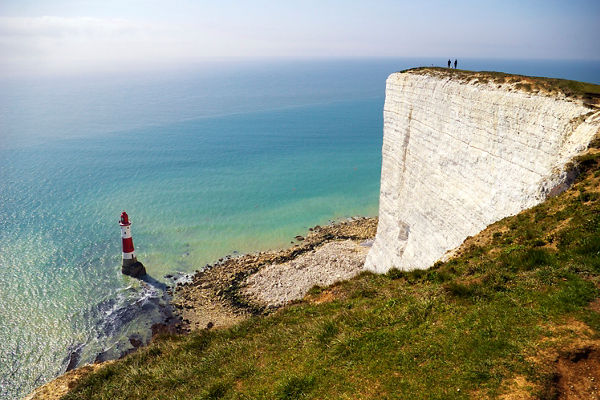
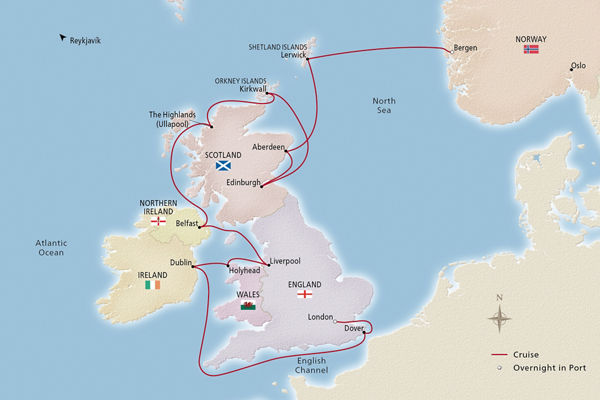
White cliffs and lighthouse by the sea
Hide map Show map

British Isles Explorer

Bergen to London (Greenwich)
Reduced Airfare | Special Fares | $25 Deposit

15 days
6 countries
$7,299 from
  • Learn More
  • PRICE & BUILD
Colorful waterfront houses in Bergen, Norway
Hide map Show map

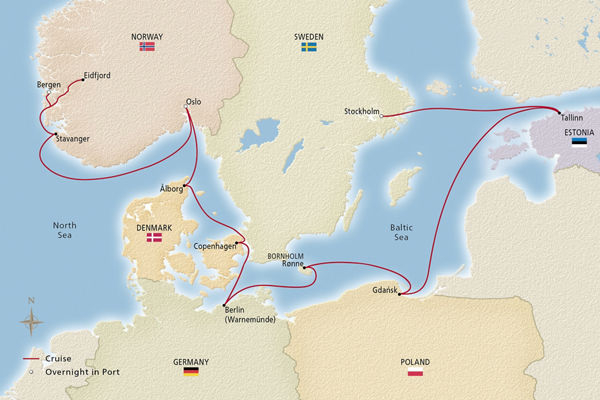
Viking Homelands

Stockholm to Bergen
Reduced Airfare | Special Fares | $25 Deposit

15 days
6 countries
$8,499 from
  • Learn More
  • PRICE & BUILD
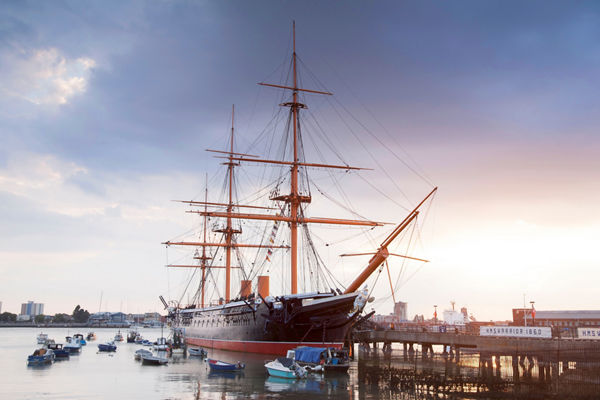
Historic ship docked at sunset harbor
Hide map Show map

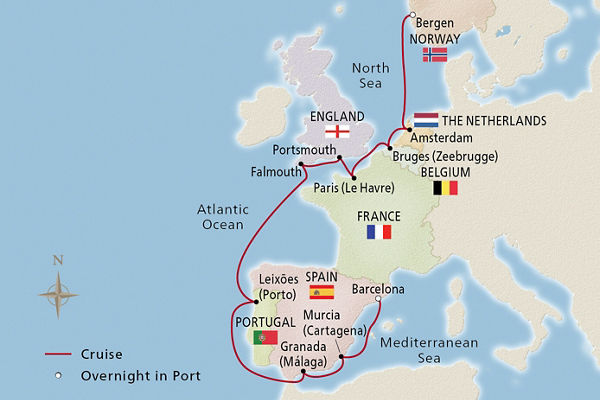
Trade Routes of the Middle Ages

Bergen to Barcelona
Reduced Airfare | Special Fares | $25 Deposit

15 days
7 countries
$5,299 from
  • Learn More
  • PRICE & BUILD
Polar bear walking across icy terrain
Hide map Show map

Iceland & Norway’s Arctic Explorer

Bergen to Reykjavík
Reduced Airfare | Special Fares | $25 Deposit

15 days
2 countries
$7,999 from
  • Learn More
  • PRICE & BUILD
View Cruises

Sign up to receive updates from Viking

Stay current with special offers, news and destination-focused content.

SIGN UP
Call Viking at
Call Viking at 1-800-304-9616
1-800-304-9616
TAP TO CALL
Viking Cruises Viking

Footnote

Ocean Cruising - Up to 35% off cruise price based on select departures and categories of Iberian Explorer; Iconic Western Mediterranean; Italian Sojourn; Mediterranean Antiquities; Trade Routes of the Middle Ages; Venice, the Adriatic & Greece.

River Cruising - Up to 35% off cruise price based on select departures and categories of Lyon & Provence, Paris & the Heart of Normandy, Holland & Belgium and other itineraries, dates and categories may vary.

Expedition Cruising - Up to 15% off cruise price based on select departures and categories of Antarctic Explorer and Panama Canal & the Americas.
  • Company Information

    • Contact Us
    • Speak with a Viking Agent
    • Order a Brochure
    • Special Offers
    • Sweepstakes
    • Travel Advisors
    • FAQ
    • Media Center
    • About Us
    • Investor Relations
    • Careers
    • Site Map
    • Legal
    • Terms of Use
    • Privacy Policy
    • Cookie Policy
  • Viking River Cruises

    • Europe
    • Asia
    • Egypt
    • Mississippi
  • Viking Ocean Cruises

    • Scandinavia
    • British Isles & Ireland
    • North America
    • Caribbean & Central America
    • South America
    • Mediterranean
    • Quiet Season Mediterranean
    • Asia
    • Australia & New Zealand
    • World Cruises
    • Grand Journeys
  • Viking Expeditions

    • Antarctica
    • The Arctic
    • Great Lakes
    • North America
    • South America
    • Grand Journeys
    • Longitudinal World Cruises

© Viking Cruises, 2026. All Rights Reserved.

Footnote

Ocean Cruising - Up to 35% off cruise price based on select departures and categories of Iberian Explorer; Iconic Western Mediterranean; Italian Sojourn; Mediterranean Antiquities; Trade Routes of the Middle Ages; Venice, the Adriatic & Greece.

River Cruising - Up to 35% off cruise price based on select departures and categories of Lyon & Provence, Paris & the Heart of Normandy, Holland & Belgium and other itineraries, dates and categories may vary.

Expedition Cruising - Up to 15% off cruise price based on select departures and categories of Antarctic Explorer and Panama Canal & the Americas.

Company Information

  • Contact Us
  • Speak with a Viking Agent
  • Order a Brochure
  • Special Offers
  • Sweepstakes
  • Travel Advisors
  • FAQ
  • Media Center
  • About Us
  • Investor Relations
  • Careers
  • Site Map
  • Legal
  • Terms of Use
  • Privacy Policy
  • Cookie Policy

Viking River Cruises

  • Europe
  • Asia
  • Egypt
  • Mississippi

Viking Ocean Cruises

  • Scandinavia
  • British Isles & Ireland
  • North America
  • Caribbean & Central America
  • South America
  • Mediterranean
  • Quiet Season Mediterranean
  • Asia
  • Australia & New Zealand
  • World Cruises
  • Grand Journeys

Viking Expeditions

  • Antarctica
  • The Arctic
  • Great Lakes
  • North America
  • South America
  • Grand Journeys
  • Longitudinal World Cruises

Call Viking at Call Viking at 1-800-304-9616 1-800-304-9616 Viking Cruises Viking
© Viking Cruises, 2026. All Rights Reserved.

2026-2029 OCEAN CRUISE AND AIR FARES: Offer applies to bookings made from November 1-30, 2026. Terms & conditions for select promotions may vary. $25 deposit is applicable to all itineraries except World Cruise products. All prices are in US dollars and for US residents only. Additional restrictions may apply.

Airfares may vary on other gateways & departures. Airfare does not have to be purchased to get cruise\cruisetour offer. All prices are in US dollars and for US residents only. Additional restrictions may apply.

2026: Pay in full by November 30, 2026 or 120 days prior to departure (whichever comes first).
2027: Pay in full by December 17, 2026 or 120 days prior to departure (whichever comes first). 
2028: Pay in full by June 10, 2027.
2029: Pay in full by February 17, 2028.

Offer may be withdrawn at any time without prior notice. Offers Expires November 30, 2026.

$25 DEPOSIT: For itineraries 35 days or less, a $25 deposit applies to April 2027 & onward departures; for itineraries greater than 35 days, a $25 deposit applies to June 2027 & onward departures; World Cruise products excluded; call for details.

AIR UPGRADE: Upgrade to Premium Economy or Business at additional cost based on select gateways and dates. Additional airline-imposed baggage charges may apply; for more information visit Airline Luggage Restrictions. Air prices are per person based on cruise/cruisetour check-in date and include transfers plus all government taxes/fees of approximately $160 and air fuel surcharges. Air seats are limited; airfares are subject to change and are not guaranteed until full payment of air is received. For more information about customized air services and US gateways, visit the Viking Air Plus page.

GENERAL RESTRICTIONS: Cruise fares listed are cruise only in U.S. dollars, per person, based on double occupancy. Single supplement savings are off applicable rates. Cruise fares listed are valid for U.S. residents only. All fares and offers are for new bookings only and are subject to availability, may not combinable with other offers except Viking Explorer Society Travel Credits, are capacity-controlled and may be withdrawn at any time without prior notice. Special fares are based upon published full brochure fares; cruise fares do not include pre-paid charges, optional facilities, and personal charges, as defined in the terms and conditions of the Passenger Ticket Contract which may be viewed elsewhere on this website. Full brochure fares may not have resulted in actual sales in all stateroom categories and may not have been in effect during the last 90 days. Promotional fares may remain in effect after the expiration date. Air promotion applies to roundtrip flights only from select Viking Cruises U.S. gateways and includes airport-to-ship or hotel transfers, air taxes and air fuel surcharges. Roundtrip airport transfers are included when air is purchased with a cruise or cruisetour package; if air is not purchased from Viking, transfers may be purchased separately. All transfers must be in conjunction with a Viking-purchased cruise, cruisetour, land extension or extra hotel nights. Viking reserves the right to correct errors or omissions and to change any and all fares at any time. For up-to-date prices, please call Viking or your Travel Agent. Additional terms and conditions may apply. Complete terms and conditions may be found in the Passenger Ticket Contract.

NOTE: International flights depart the U.S. one day prior to check-in date. Paid Business or Premium Economy Class may require travel in economy on flights within North America or Europe. Premium economy is limited to specific airlines and we may not be able to accommodate based on aircraft type and availability. Roundtrip airport transfers are included when air is purchased with a cruise or cruisetour package; if air is not purchased from Viking, transfers may be purchased separately. All transfers must be in conjunction with a Viking-purchased cruise, cruisetour, land extension or extra hotel nights.