

Embark on an epic Longitudinal World Cruise
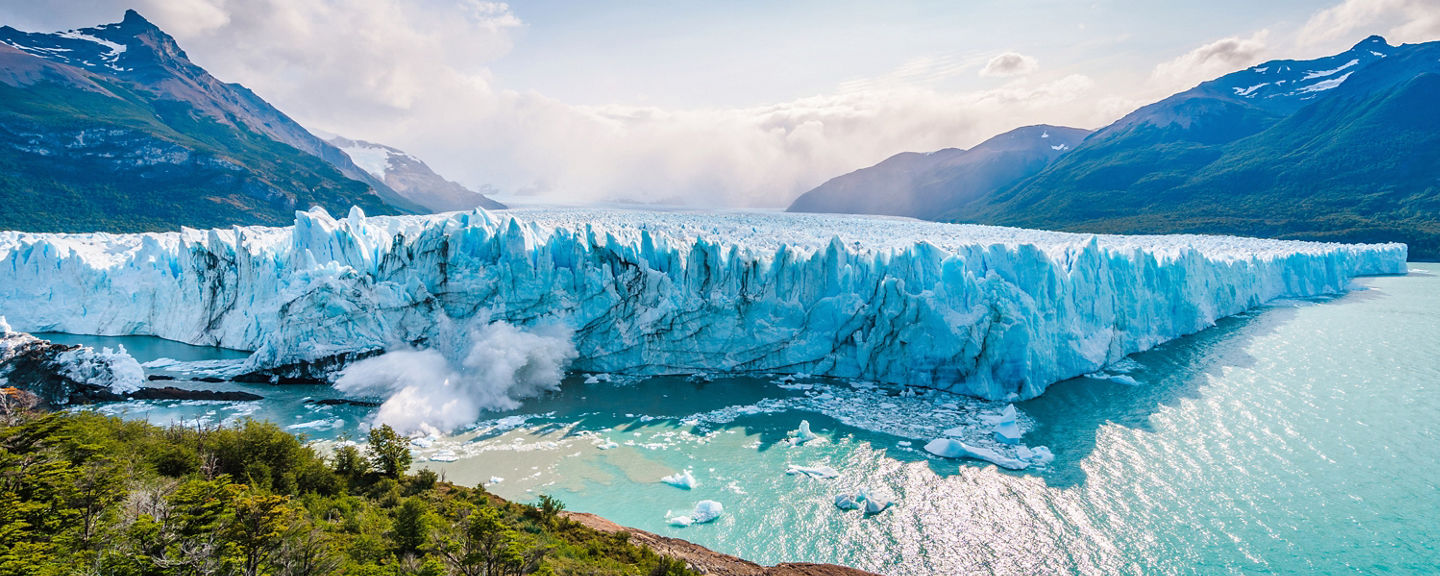
A Longitudinal World Cruise offers a unique way to experience some of the world’s most intriguing destinations, spanning the waterways and oceans between Greenland and the Canadian High Arctic and Antarctica. Read on to enhance your knowledge of longitude, discover culinary favorites from across the Western Hemisphere, delve into the history of Canada's Innucadie people and learn about the remarkable Greenland Ice Sheet.
Longitudinal World Cruises
Longitude, marked by parallel lines extending east and west from the prime meridian, functions both as a measure of distance and time. A difference of 15° longitude corresponds to a one-hour time difference, based on a given location’s relation to the sun.
The ancient Greek geographer Marinus of Tyre (c.70–130 AD) was the first scholar to advance the idea of latitude and longitude as measurable distances. His zero meridian—0˚ N latitude, 0˚ E longitude—was located in what he called the “Islands of the Blessed,” an earthly paradise at the edge of the known world. Today, these are the islands of Macaronesia, an archipelago that includes the Azores, Madeira, Cape Verde and the Canary Islands.
While Marinus of Tyre’s ideas were highly influential, our understanding of the world—and its geography—have shifted dramatically over time. Today, the zero meridian is located at “Null Island,” which is not an island at all. Instead, it is a spot in the Gulf of Guinea marked by an unassuming buoy, where the ocean is more than 16,000 feet deep.
Pinpointing the zero meridian and accurately calculating longitude proved to be a difficult endeavor. During the Age of Discovery, brilliant minds worked to solve this vexing navigational problem, but they all failed to devise a tool that could function on the rolling deck of a ship in the salty sea air.
That changed during the 18th century, when—after 31 years of toil and experimentation—English clockmaker John Harrison (1693–1776) presented his marine chronometer, which allowed sailors to keep the time of a fixed location. During the 1884 Prime Meridian Conference, that fixed location was standardized for all navigators as the prime meridian, set at 0° longitude in Greenwich, England.
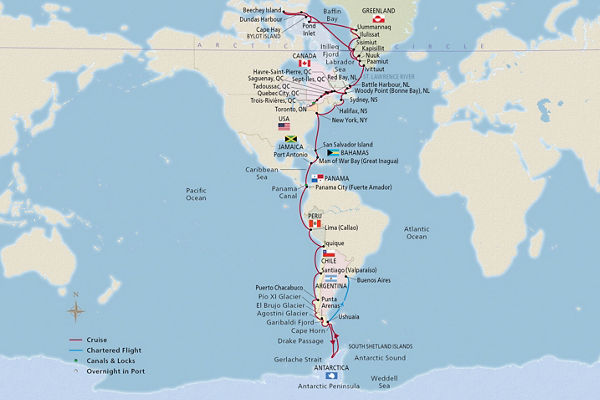
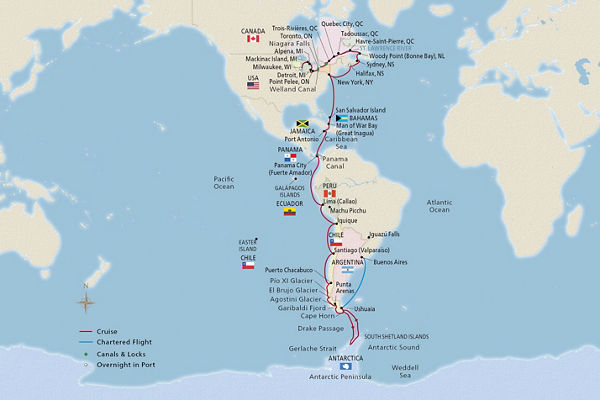
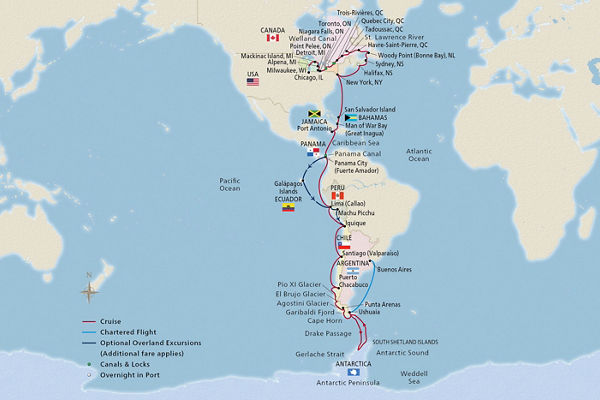
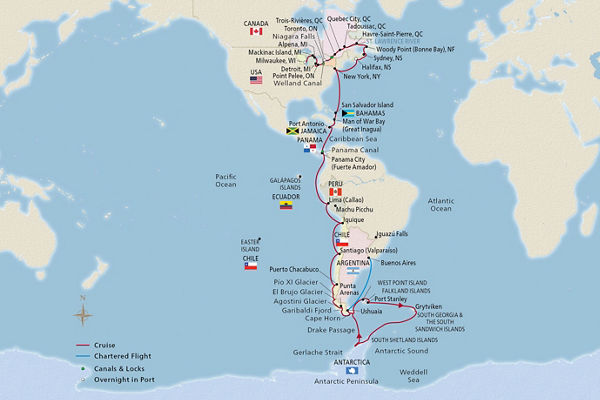
A Longitudinal World Cruise from Nuuk, Greenland (51° 44' W) to Ushuaia (68° 18' W) roughly traces the meridian that lies 70° west of Greenwich, which extends from the North Pole to the South Pole across Greenland, North America, the Atlantic Ocean, South America, the Southern Ocean and Antarctica. Although it begins further west and ends further east, a Longitudinal World Cruise from Milwaukee (87° 54' W) to Buenos Aires (58° 22′ W) also roughly follows the 70° W meridian.
Along this route, here are some of the remarkable sights travelers may encounter:
- Ilulissat Icefjord
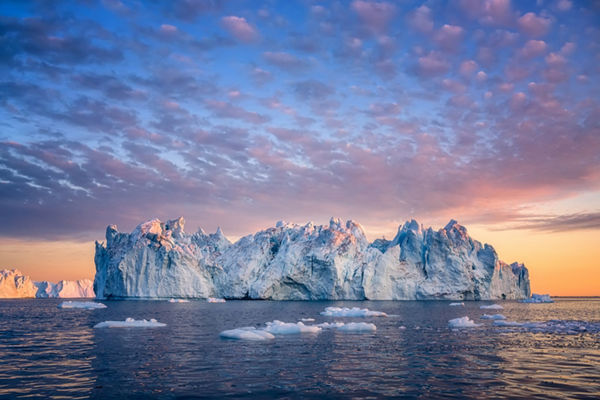
This UNESCO World Heritage Site is one of the few places where Greenland’s ice cap reaches the sea. The fjord is fed by the Sermeq Kujalleq, one of the fastest moving and most active glaciers in the world. - Gros Morne National Park
The second largest national park in Canada, Gros Morne is situated on the west coast of Newfoundland. In 1987, the park was awarded World Heritage Site status by UNESCO because it provides a rare example of the process of continental drift. - Metropolitan Museum of Art
Located on the eastern edge of New York’s storied Central Park, the Met is the largest museum in the United States. It houses cultural artifacts that span more than 5,000 years of human history, from classical antiquity to the present day. - Atacama Desert
With its salt plains and bizarre rock formations set against a backdrop of giant volcanoes, this breathtakingly stark Chilean landscape offers visitors an otherworldly experience. - Chilean fjords
These picturesque fjords stretch nearly 1,000 mi. (1,609 km) from Cape Horn to the Reloncaví Estuary. Their majestic shores are home to colonies of Magellanic penguins and elephant seals, while their waters welcome dolphins, migrating humpback whales and orcas. - Antarctica
The pristine, snow-covered shores of Antarctica have intrigued explorers for centuries. Kayak among blue-tinged glaciers, partake in a shore landing and keep watch for extraordinary wildlife—including humpback whales, Weddell seals and Adélie penguins—as you explore the “White Continent.”

-
Foods from the Arctic to Antarctica
One of the highlights of a Longitudinal World Cruise is sampling a wide range of cuisines. From the game-rich forests of Canada to the warm waters of the Caribbean, these diverse destinations offer a plentiful array of ingredients, cooking styles and culinary traditions. Here are eight favorite dishes that travelers may wish to try as they traverse the Western Hemisphere:
- Qaleralilaat (Greenland)
This traditional Greenlandic halibut porridge is fatty, creamy and warm—the perfect complement to cold weather. It is often served with potatoes or flatbread. - Tourtière (Quebec)
Tourtière is a hearty and satisfying French-Canadian meat pie. In coastal areas, it is sometimes filled with fish, while pork, beef, rabbit or other wild game are more common inland. Although it is traditionally served at Christmastime, this savory dish is available year-round. - Lobster Boil (Nova Scotia)
An authentic Nova Scotian lobster boil is a lively, delightfully messy affair traditionally held outdoors. Fresh lobster is, of course, the star ingredient, accented only with butter, lemon or white vinegar. - Jerk chicken (Jamaica)
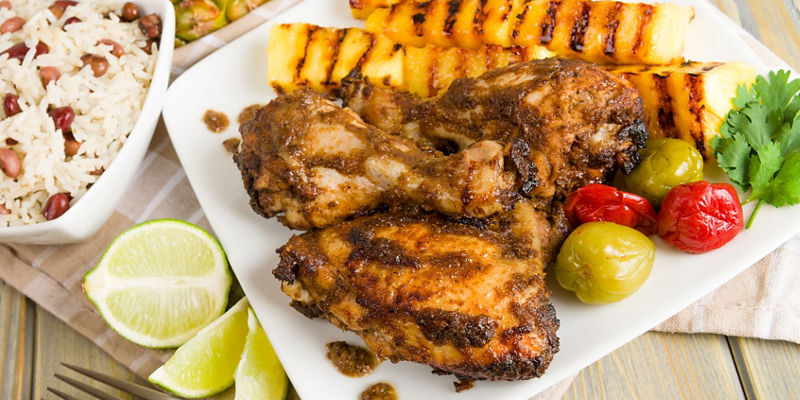
This famous Jamaican dish is bursting with flavor, thanks to its signature blend of spices and Scotch bonnet peppers. The chicken is marinated before being grilled over an open flame, giving the meat its characteristic smoky and spicy taste. - Sancocho de Gallina (Panama)
This rich, hearty stew features chicken simmered with starchy vegetables like potatoes, yuca or plantains, creating a savory broth. Its unique flavor comes from culantro, an herb that is slightly sweeter and stronger in flavor than cilantro. - Ceviche (Peru)
This classic Peruvian dish has become famous around the globe, but it is especially delicious when eaten in its birthplace. The traditional version consists of fresh fish marinated with limes and rocoto peppers. It is often served with onions, corn and sweet potatoes. - Pastel de choclo (Chile)
This traditional Chilean pie consists of ground beef, chicken, onions, olives and hard-boiled eggs. It is topped with a layer of corn batter then baked until golden. The combination of sweet and savory flavors makes this hearty dish a consistent favorite at family gatherings and special occasions. - King crab (Argentina)
Travelers to Ushuaia and Tierra del Fuego have a unique opportunity to taste the wonderfully fresh king crab that comes from the region’s icy coastal waters. One of the most popular ways to order it is boiled—with no additional garnishes or sauces—so that the sweet, pure flavor can shine.
- Qaleralilaat (Greenland)
-
The Innucadie of Havre-Saint-Pierre
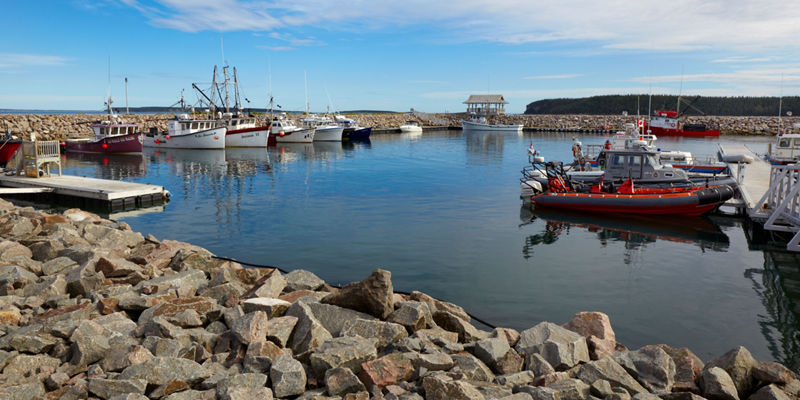
The Canadian city of Havre-Saint-Pierre is home to the Innucadie people, who have persevered despite a tumultuous history involving wars and relocation. Today, the Innucadie are a vital part of the Havre-Saint-Pierre community and the Minganie region of Quebec.
The history of the Innucadie begins with the Acadians, a group of French settlers who arrived in North America in the early 1600s. The first arrivals, led by explorer Samuel de Champlain, settled on Saint Croix Island, which today is on the border between Maine and New Brunswick. After a difficult first year where many died, the settlement moved to Port Royal on the coast of Nova Scotia. There, the community began to thrive.
The Acadians expanded their territory over the next century but clashed repeatedly with the British over land. The conflict came to a head during the French and Indian War (1755–1763). After the British emerged victorious, the Acadians were treated harshly and driven from their lands during a period known as the Le Grand Dérangement (The Great Upheaval).
Some of the displaced Acadians went south towards Louisiana, where their descendants would be known as Cajuns. Others found their way to Îles-de-la-Madeleine and later to what is now Havre-Saint-Pierre. Here, the Acadians encountered the Innu, the Indigenous people who inhabited the region for thousands of years. The Innu were welcoming and helped the Acadians survive the harsh northern winters and acclimate to their new surroundings. Instead of fighting over territory, the two cultures lived peacefully among each other. The ensuing decades saw the Acadian and Innu communities form strong bonds and fuse into one new culture, known as Innucadie.
The Innucadie preserved many of the Innu’s cherished traditions, such as storytelling and poetry, while Acadian heritage has also been kept alive, most notably in the local cuisine. The rich history of the Innucadie is recognized through various events throughout the year. For example, the Stories and Legends Festival invites artists and artisans from different communities to celebrate their heritage. Held each year in August, the festival features music, dancing and storytelling, providing a platform for both Indigenous and non-Indigenous communities to come together. The story of the Innucadie is one of resilience and a reminder of the importance of preserving our shared histories.
-
The research stations of Antarctica
Antarctica is the most remote and mysterious continent on Earth. The immense sheet of ice covering nearly all of Antarctica’s polar desert surface represents around 90 percent of the world’s total ice volume. Antarctica is also home to sand dunes, a lake and an active volcano called Mt. Erebus, but they are buried by snow and ice. Only a limited number of flora and fauna can survive on land in the dry, barren conditions, most notably the continent’s lichen and penguins. Antarctica’s frigid seas, however, are teeming with life ranging from whales, seals and octopuses to sea spiders, bioluminescent swimming worms and miniature crustaceans. Since the signing of the Antarctic Treaty in 1959, the continent has been preserved as a demilitarized zone and a haven for scientific research.
Today, there are 70 permanent research stations scattered across the continent of Antarctica. They are operated by researchers and scientists who represent 29 countries from across the globe and are the continent’s only human inhabitants. For hundreds of years, the scientific world has been drawn to the pristine and fascinating “White Continent” to study weather patterns, geology, paleontology, wildlife and more. Research performed in Antarctica has helped to highlight global issues like climate change, rising ocean levels and ozone layer depletion. The earliest explorers to this region—like Roald Amundsen and Ernest Shackleton, who lived and worked in wooden huts—would be amazed to see what a modern Antarctic research station looks like today.
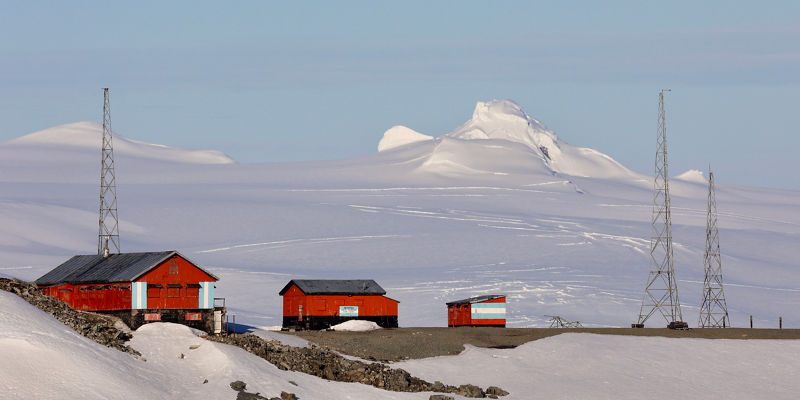
The oldest existing research station in Antarctica is Orcadas Base, first established in 1903 on Laurie Island by the Scottish National Antarctic Expedition. In 1904, it was transferred to the Argentine government. The building was little more than a dry stone cabin. This was the only permanent base in Antarctica until the British established Cape Geddes Station on Laurie Island in 1946. Later in 1962, the US built its McMurdo Research Station on Ross Island, the largest on the continent.
While the first Antarctic research stations were modest in scope, today they feature futuristic design and technology. For example, South Korea’s Jang Bogo Station in Terra Nova Bay is a massive, 3-winged structure. Constructed in 2014, the state-of-the-art base covers 47,985 sq ft (4,458 sq m) and features an aerodynamic outer shell to resist the strong Antarctic winds.
India’s Bharati station, which opened in 2012, also features an innovative, modern design with an imaginative twist. The structure was built from 134 prefabricated shipping containers. Bharati’s research focuses on oceanographic studies and the phenomenon of continental break up. In 2020, Brazil opened Commandante Ferraz Station, a sleek 100-million-dollar facility. The base is built on the same site as the previous Brazilian station on King George Island.
While many individual countries have constructed research stations in Antarctica, the land is managed through a system of international cooperation, and no nation owns the continent. Few people will ever get to see these amazing Antarctic stations, but the research conducted here could benefit the Earth for generations to come.
Longitudinal World Cruises Highlights
A Longitudinal World Cruise is thoughtfully designed to immerse you in the rich histories, vibrant cultures and awe-inspiring landscapes of North, Central and South America, as well as Antarctica. Depending on the itinerary, here are some highlights you may experience:
- Listen to the tales of a traditional Inuit storyteller
- Sail through the pristine waters of the Ilulissat Icefjord
- Discover the stark polar landscapes of the Canadian High Arctic
- Explore Quebec City’s Old Town, a UNESCO World Heritage Site
- Visit Toronto's renowned Art Gallery of Ontario
- Enjoy an authentic Nova Scotian lobster boil
- Take in the majesty of the world-famous Niagara Falls
- Keep watch for pink flamingos in the Bahamas
- Hike through the lush rainforests of Jamaica
- Traverse the legendary Panama Canal
- Sample local wines in Chile’s scenic Casablanca Valley
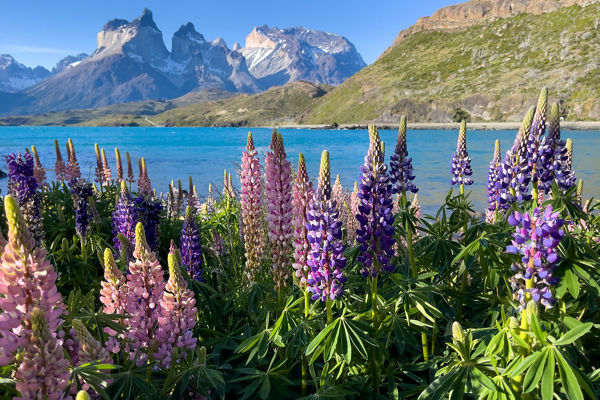
- Journey into the awe-inspiring Patagonian wilderness
- Navigate past Cape Horn, the tip of South America
- Kayak among the majestic, blue-tinged glaciers of Antarctica
Destination Insight Videos

Discover a vibrant cultural hub in Canada with Jean Newman Glock (23:12)
Join VikingAmbassador-at-Large Jean Newman Glock as she travels “Beyond the Brochure” and explores the hidden gems of the Great Lakes region. Follow Jean through Canada’s largest city, Toronto, where history seamlessly blends with urban charm along the shores of Lake Ontario. First, she strolls the cobblestone streets of the iconic Distillery District and encounters a one-of-a-kind dog sculpture. Then, Jean indulges in an array of culinary delights, including a true Canadian favorite—a maple bacon sandwich. Find inspiration to plan your own voyage to Toronto and the Great Lakes region on one of our expedition itineraries.

Discover the culinary delights of Buenos Aires (15:38)
Explore the Argentine capital’s vibrant food scene and visit iconic eateries that you can experience on one of our ocean or expedition journeys that calls on Buenos Aires. Your host, a local tour guide, begins the episode with a warm coffee and buttery medialuna pastry at historic Café Tortoni, then savors some of Argentina's finest wines at El Querandí. Next, follow your host to the San Telmo Market, where sizzling parrillas (cast iron grills) are used to cook steaks to perfection. Finally, your host introduces you to traditional mate, a beloved tea-like beverage, before participating in a hands-on empanada-making experience.

At Home in Santiago (28:03)
Explore the heart of modern Santiago, one of the largest cities in the Americas. Follow your host to the Museo Precolombino, where ancient artifacts tell stories of pre-Columbian civilizations. Then, marvel at the Plaza de Armas, home to the grand Metropolitan Cathedral of Santiago, and discover La Moneda, Chile’s elegant presidential palace. Explore local Chilean dishes at El Galeón, a renowned market, and discover winemaking traditions at Santa Rita vineyard. You will also have an opportunity to discover artisanal handicrafts at Los Dominicos village.

Guest Reviews: Antarctica Expeditions (1:41)
Hear from guests who have explored Antarctica with Viking and praised it as one of their best-ever travel experiences.

Caribbean Batik (2:15)
Using time-honored techniques perfected in the Far East and Africa, island artists produce distinctive batik garments with a Caribbean flair. Discover the steps they take to create elaborate designs on fabric.

Discover the Great Lakes region with Jean Newman Glock (49:46)
Join Viking Ambassador-at-Large Jean Newman Glock as she travels “Beyond the Brochure” and explores the hidden gems of Lake Michigan and Lake Huron. In Alpena, MI, Jean visits the Thunder Bay Marine Sanctuary where she uncovers the remarkable efforts being made to preserve the shipwrecks resting beneath the waves. Then, she journeys to Algoma, WI, on Lake Michigan to raise a glass to the picturesque von Stiehl Winery and sample local varietals. Finally, Jean arrives at Mackinac Island and heads to the iconic Grand Hotel to enjoy tea with a resident historian who sheds light on how the hotel survived Prohibition.
Longitudinal World Cruises Travel FAQ
All-Inclusive Itineraries—Longitudinal World Cruises
Choose one of our enriching, all-inclusive voyages and discover the many benefits of exploring in Viking comfort.